The Roseberry Archives

Square

Roseberry At 100

Edwin S. Roseberry was born July 4, 1925. It was 99 years to the day after Thomas Jefferson’s death at Monticello, near Charlottesville. Ed Roseberry would live a long life -97 years- pursuing his passion of photography for most of it.

I met Ed in his later years. He had returned to Charlottesville after spending several “retirement” years in Hawaii, a place he first experienced during his service in the Navy during WWII. Ed and I lived in the same neighborhood and I used to see him driving his Cadillac. I would later learn that was just one of the many Cadillacs he owned over the years. He also kept one of his oldest models, a 1941 Cadillac Fleetwood he purchased used a couple of years after he graduated from UVA in 1949.

When I discovered Mr. Roseberry had done some aerial photography over Charlottesville (something I was pursuing at the time) I was intrigued and arranged to meet with him. He shared a trove of fascinating photographs viewing Charlottesville and the University of Virginia from above. We compared images and discovered there were many parallels in the locations, views, and angles we both shot- decades apart- and that lead to discussion of presenting some “Then & Now” pairings of our aerial photographs.

From there, Ed began sharing more from his archive including photographs of student life at UVA, scenes from around town, photos of architecture, businesses, and portraits. His legendary images of events in and around the University, including photos of the notoriously active party scene there, earned him the nickname, “Flash” since there was usually a flash mounted on his Rolleiflex Twin Lens Reflex camera. He would own and use a wide collection of cameras throughout his career and amass well over 150,000 prints and negatives. Over the years many of his images were published in magazines and newspapers and his work slowly became part of the history of Mid- 20th Century Charlottesville. Using photographs from his archives Ed and I began hosting some exhibits and talks together to share more of his work with the enthusiastic Charlottesville public and UVA alumni. At some point he revealed he wanted to publish a book of his work and I offered to make this a reality for him. In 2016 we published “FLASH: The Photography of Ed Roseberry.”

The book was well-received and two more books were completed, both containing a generous selection of Roseberry photographs alongside other Charlottesville photographers. Those next two books were “Charlottesville Then & Now”, and “Vintage Charlottesville.” Book signings and interviews were a regular occurrence for Ed, at the time he was well into his 90s. He used to joke that he left Charlottesville for Hawaii as an ordinary photographer and returned to discover he was part of Charlottesville history and
local lore.

In honor of his 100 birthday, Vintage Charlottesville (C’ville Images) will share more of Ed’s work in the coming months, including images that haven’t been published -or maybe even shown- anywhere before. To start, we are launching “The Roseberry Archives” with some of his work from the 1940s-1970s and we will continue to add to this online collection. The first two books in our series are sold out (and won’t likely be reprinted soon) but the third book, “Vintage Charlottesville” which includes an extensive
selection of Ed’s photos is available at our online store, as well as a couple of locally-owned shops, Blue Whale Books (downtown), and The Virginia Shop (at Barracks Road Shopping Center). Check back to this website occasionally for new additions and updates as we keep Ed Roseberry’s legacy alive for new and old fans alike.

Steve Trumbull
4 July 2025
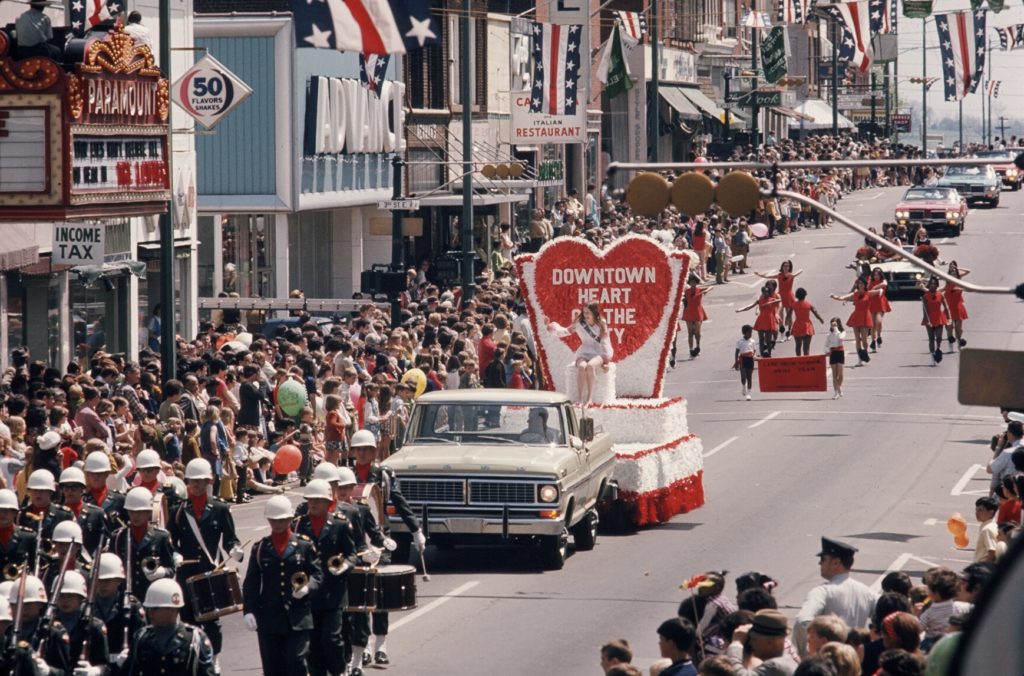
Dogwood Festival Parade, Main Street, 1970. This was just a few years before the downtown section of Main Street would be converted into a pedestrian mall.

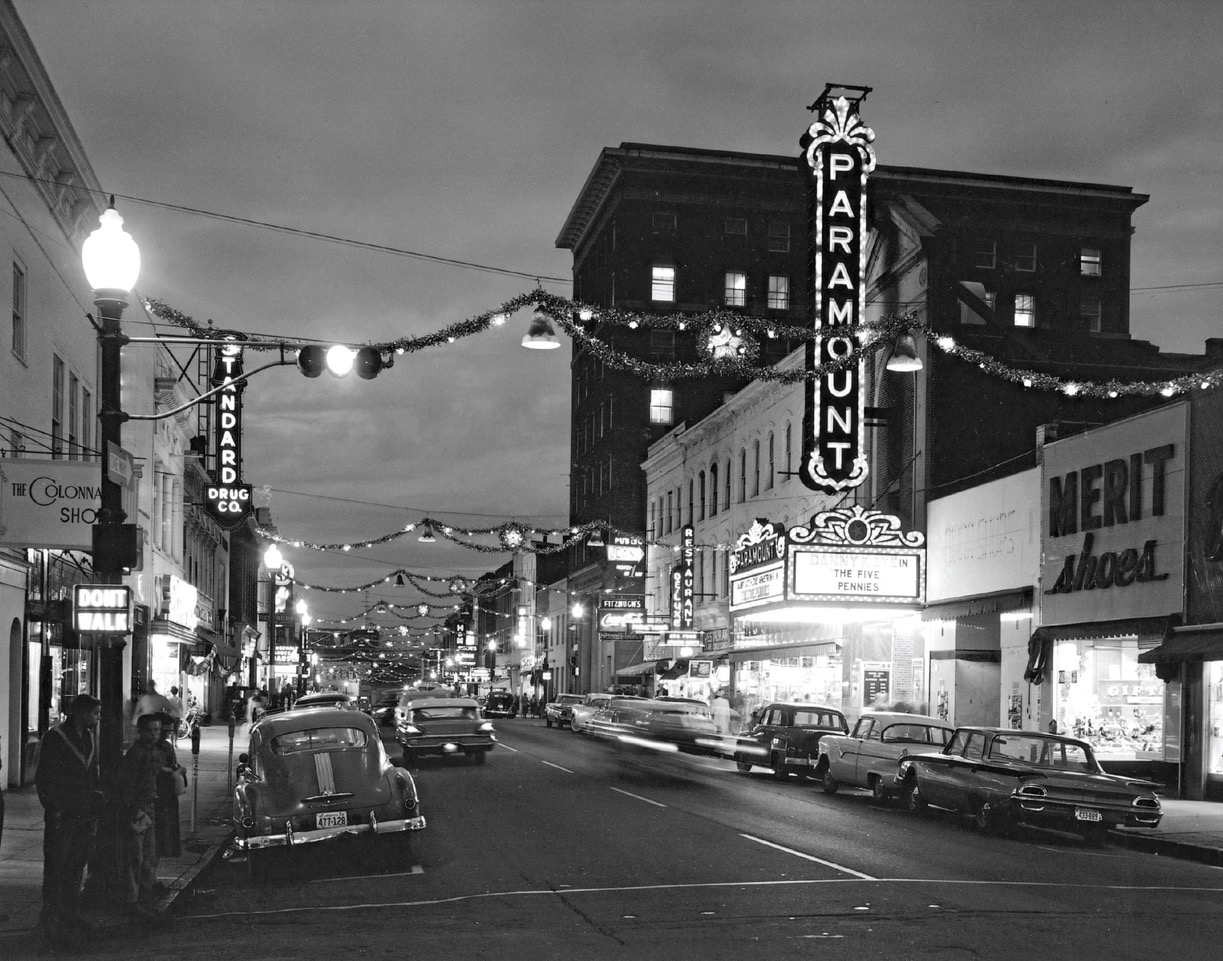
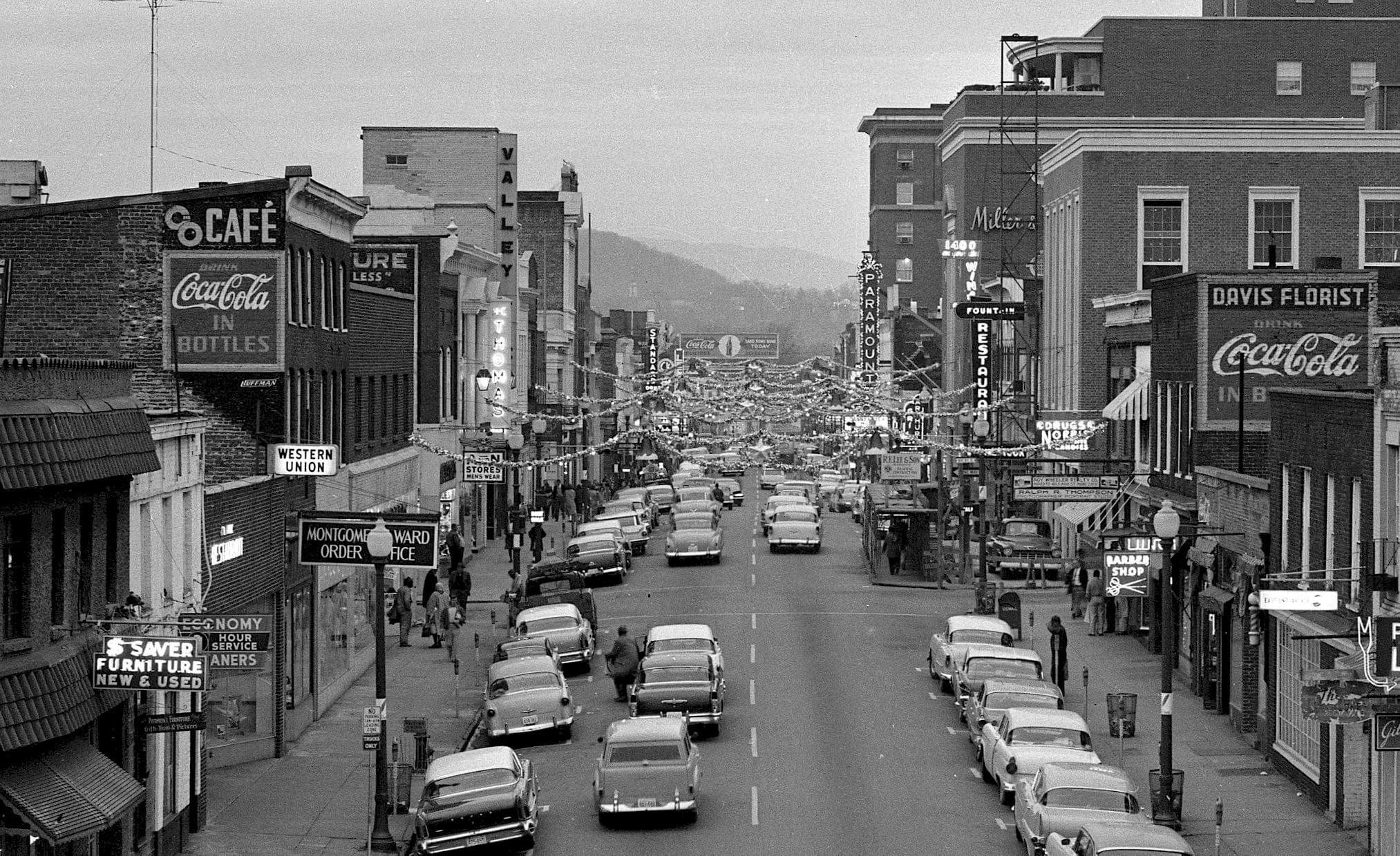
200 block of East Main Street in Downtown Charlottesville with holiday lights near the Paramount Theater, December 1959.

Downtown Charlottesville, looking toward Vinegar Hill, from First & Main Streets, mid-1960s. Notice the commercial and residential buildings on Vinegar Hill have been removed as part of a federal program of urban renewal. It would be many years before new construction would begin there, although several of the buildings seen here on Main Street still stand today.

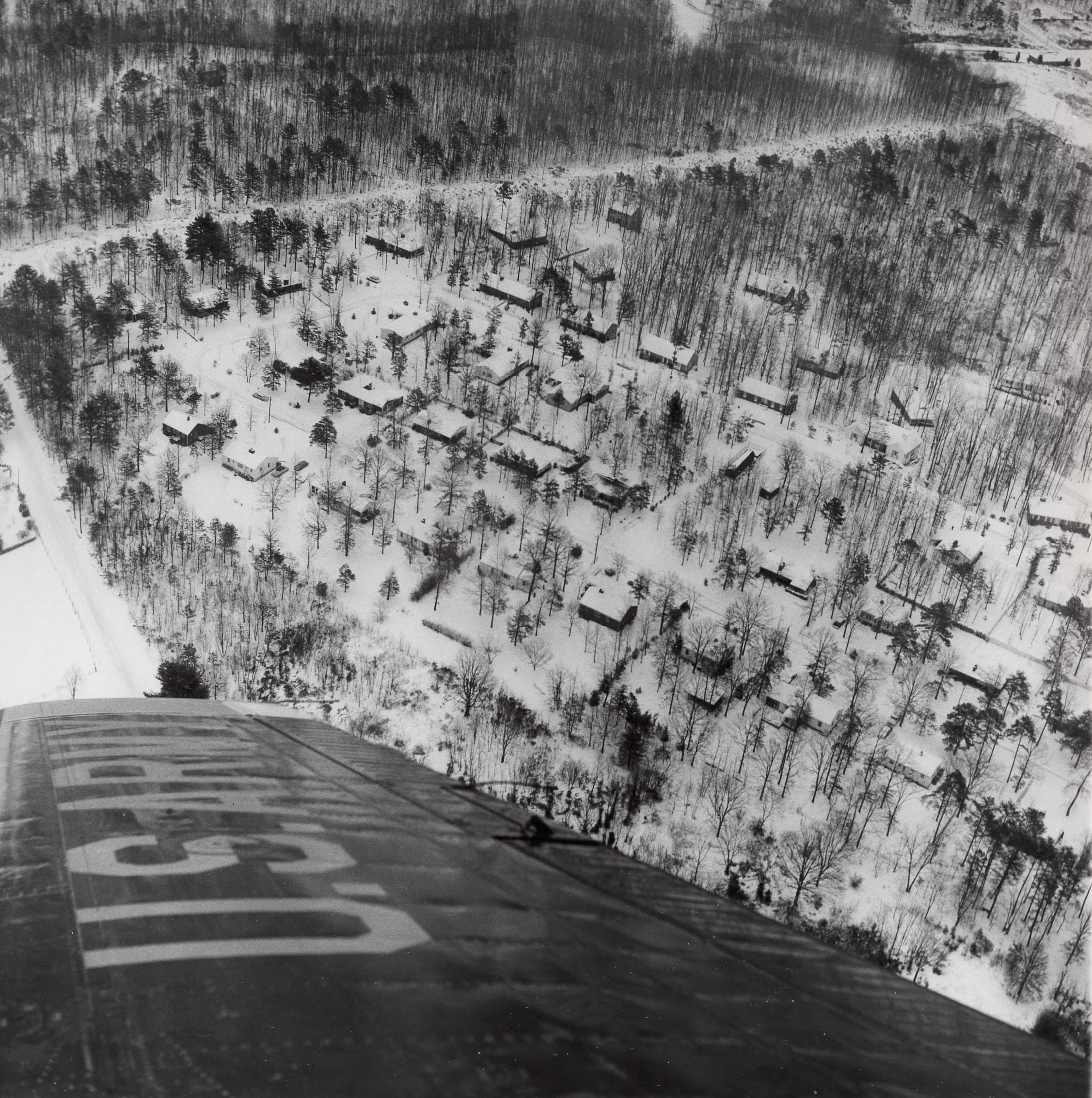
Ed Roseberry photographed this Charlottesville neighborhood near Georgetown Road from a U.S. Army aircraft piloted by his brother Bob on a cold, snowy day in the early 1960s. Note the airplane’s wing in the lower portion of the image.

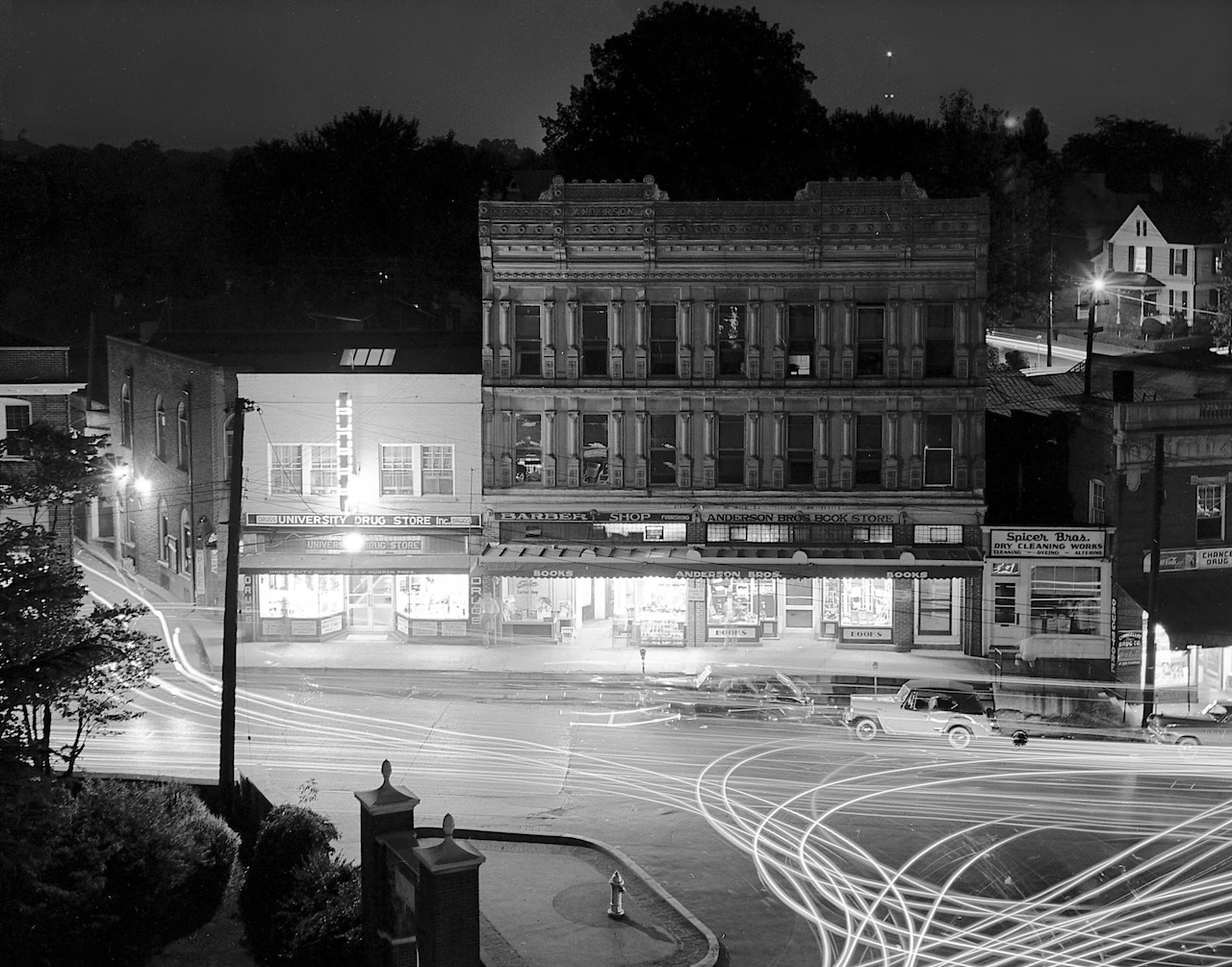
Timed exposure taken from the roof of the Medical Center at UVA looking across to The Corner, late 1940s.

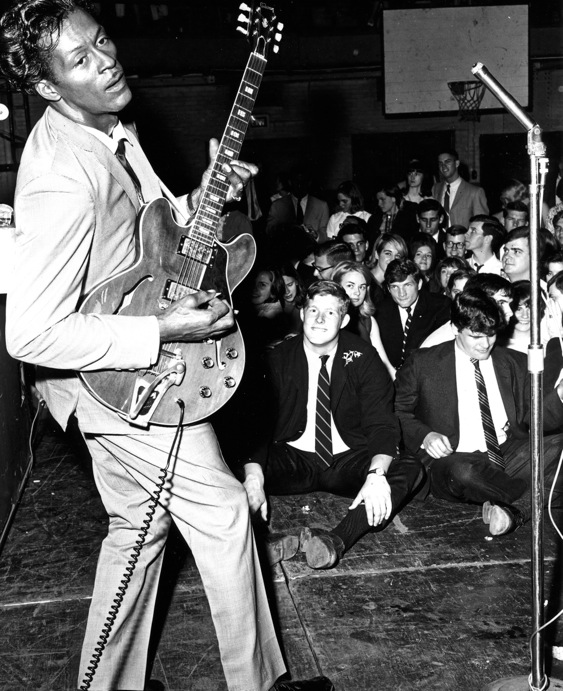
Early Rock& Roll great Chuck Berry performing at Memorial Gymnasium at UVA in 1965. “Flash” Roseberry, in his trademark way, managed to briefly get close to the performer and take a single flash photograph which captures the setting perfectly as Berry played to enthusiastic UVA students packed into the venue.

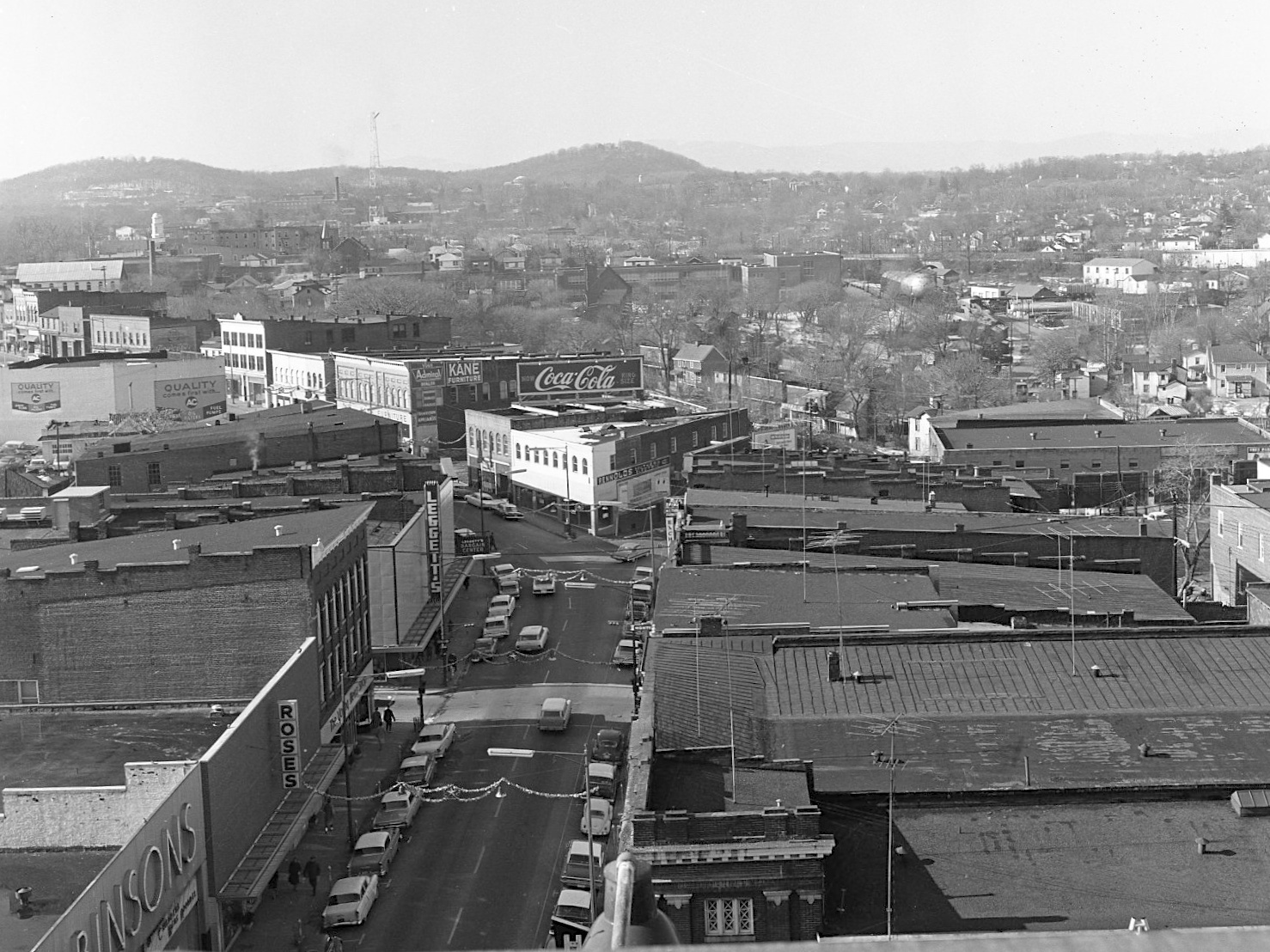
This view looking west was taken from the National Bank Building at Second and Main Streets, N.E. It was taken before the demolition of the buildings on Vinegar Hill (center of photograph) and the residential neighborhood just beyond. Circa 1960.

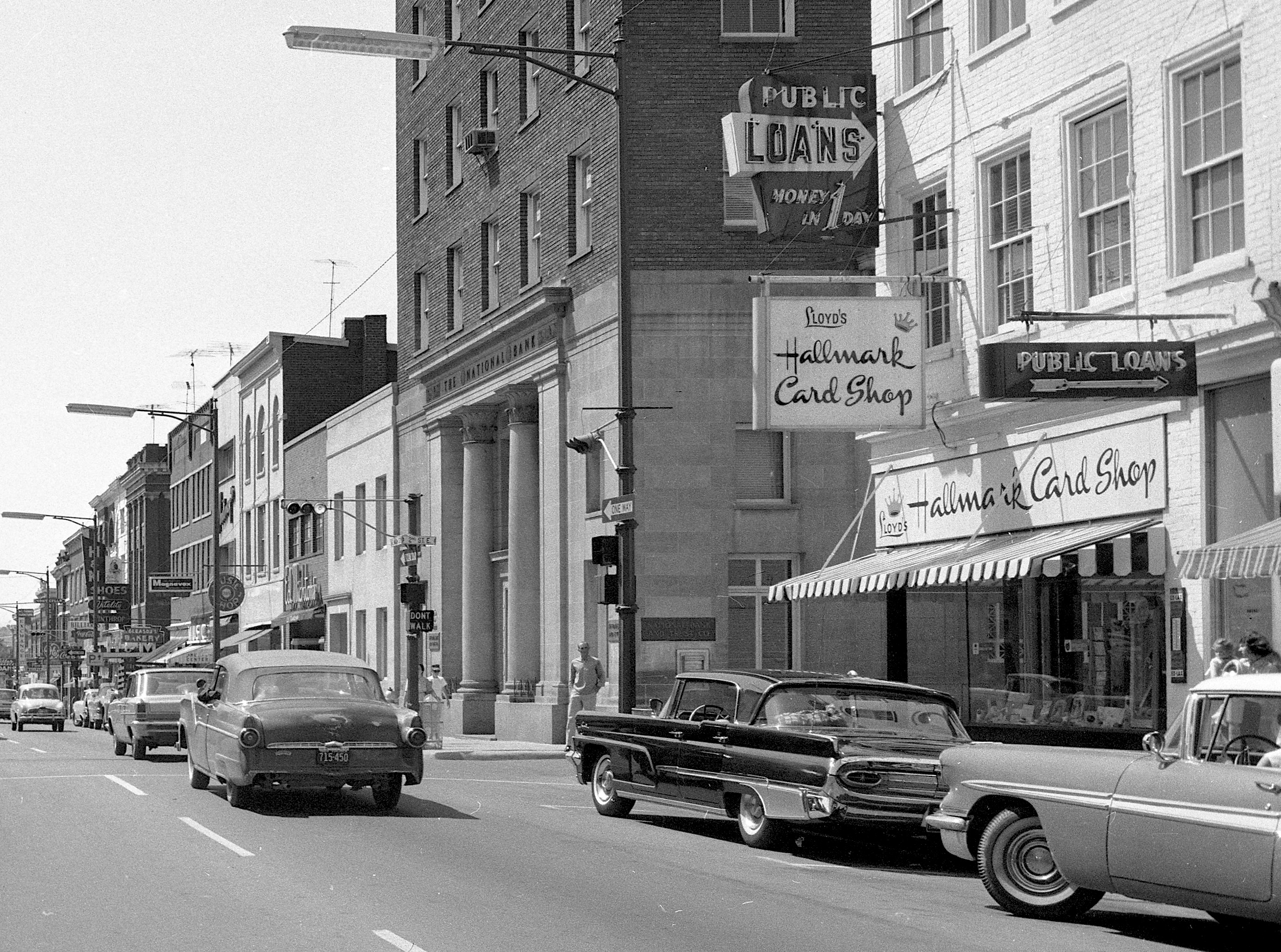
The corner of Second and Main Streets, N.E., 1964. The buildings on the right were lost to a fire in 1973 and that part of Main Street was redeveloped as Central Place with the construction of the pedestrian mall.

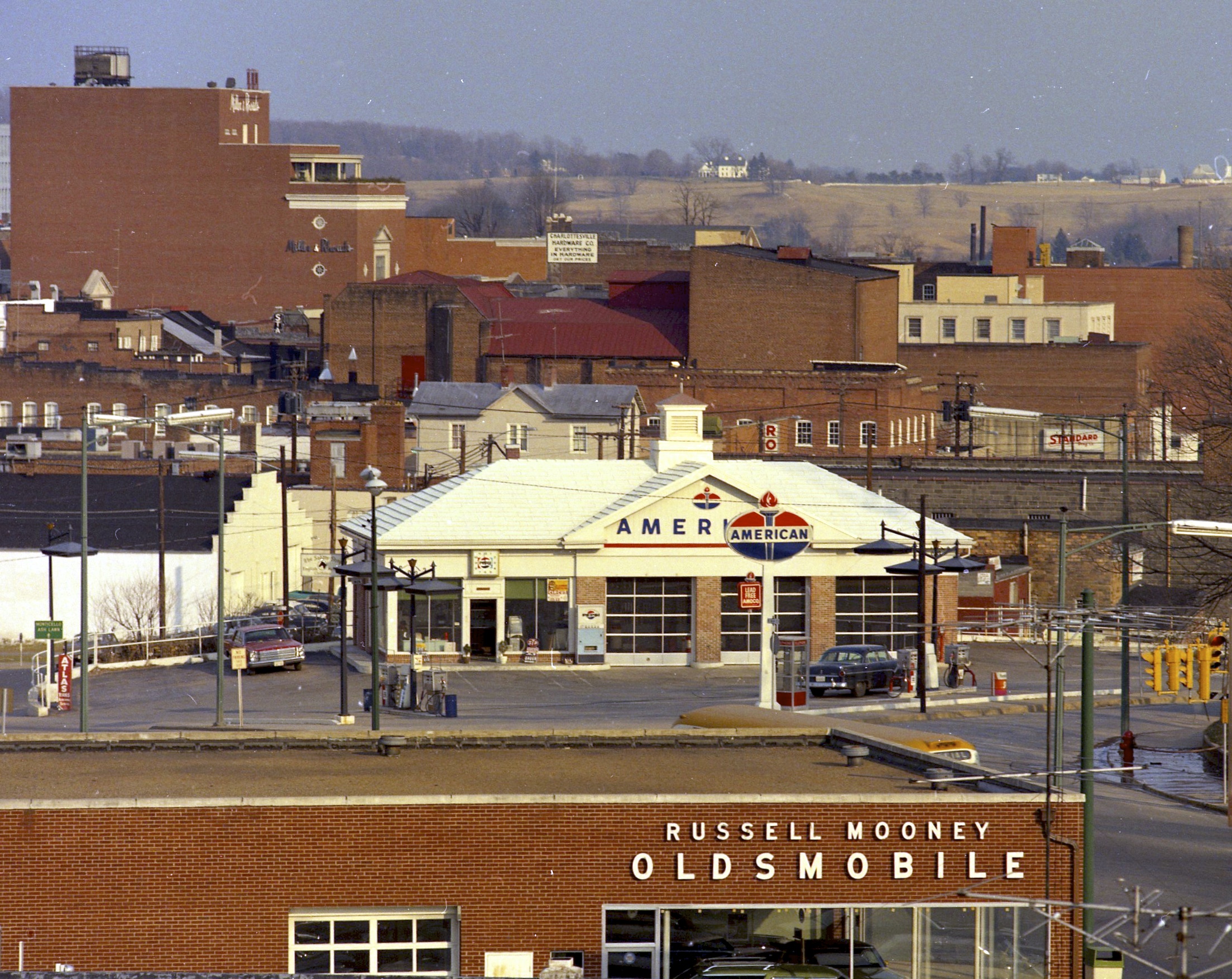
This early-1970s photograph was taken from a building on West Main Street looking back over Downtown Charlottesville toward an undeveloped Pantops Mountain. In the middle-distance you can see Miller & Rhoads and the Jefferson Theater. Both of those buildings are still there. In the foreground you can see Russell Mooney Oldsmobile Dealership and an American (later Amoco) station. Both of those are long-gone.

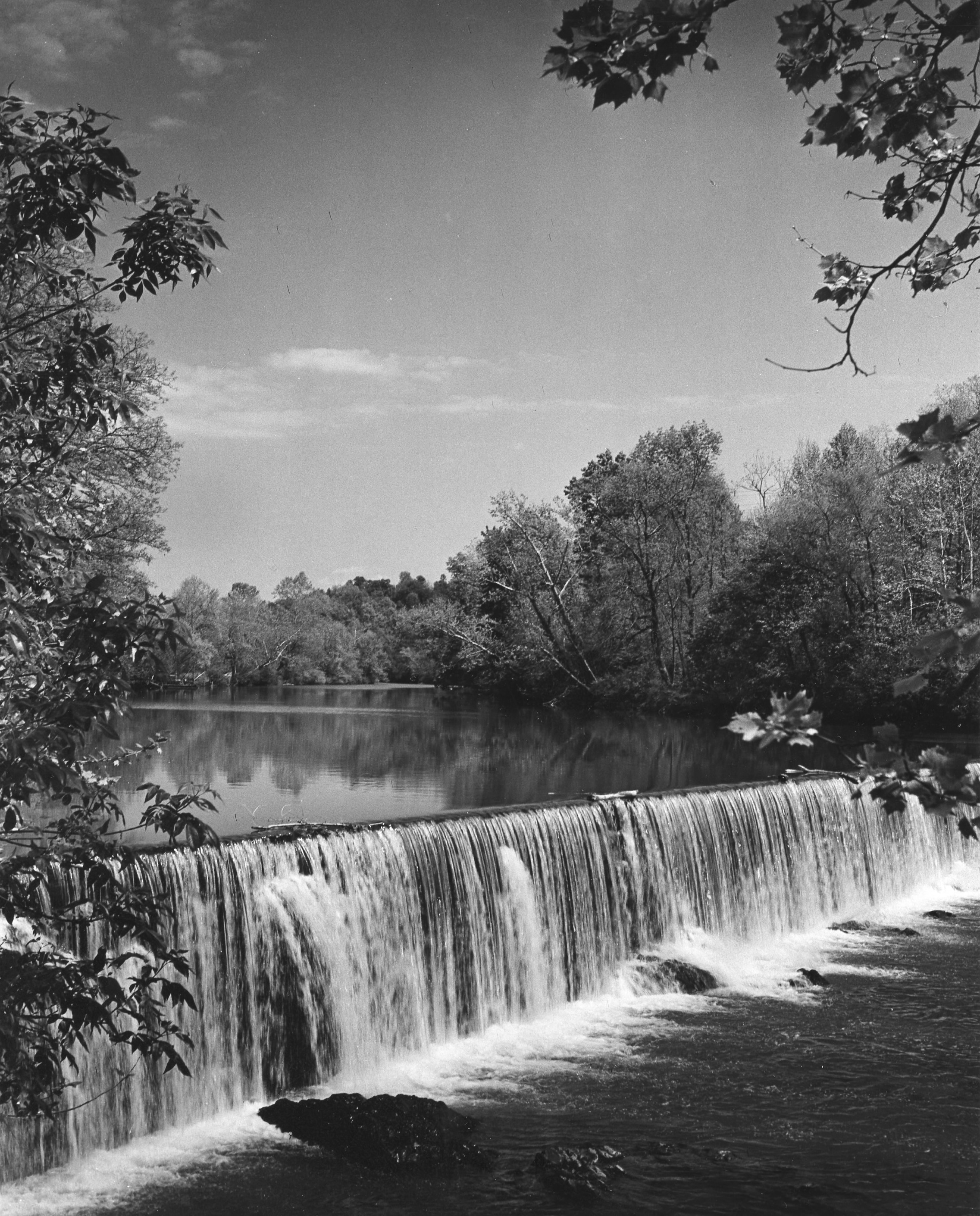
Dam at Woolen Mills, circa 1968. The dam was removed in recent years.

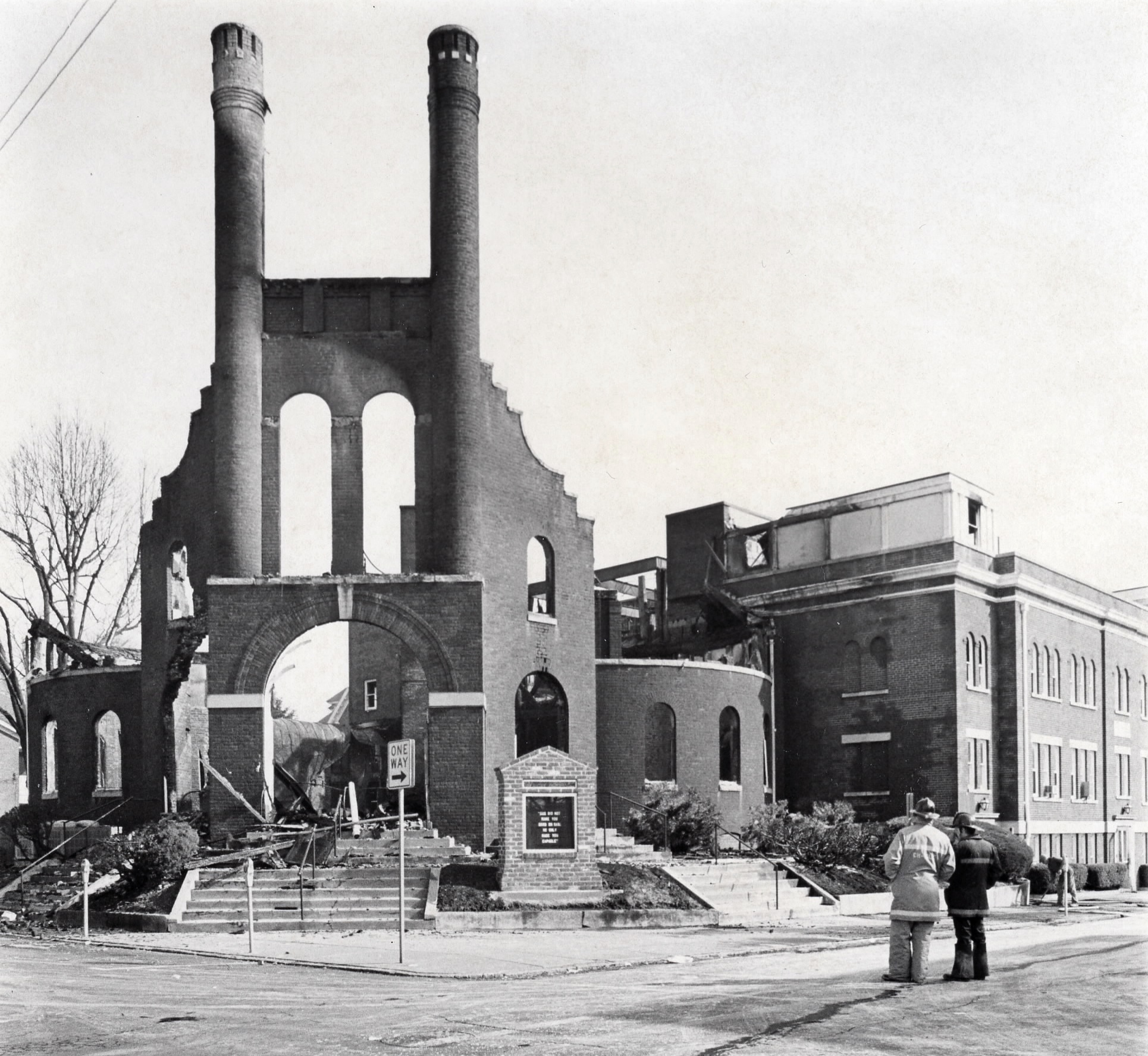
A February 1977 fire destroyed the First Baptist Church on the corner of Second and Jefferson Streets, N.E.  Built on this location in the early 20th Century, the brick church was designed in the Romanesque Revival style. The front door faced diagonally toward Lee Park. An ornate belfry located between the columns seen here was destroyed by the fire. The congregation now worships at their current location on Park Street.

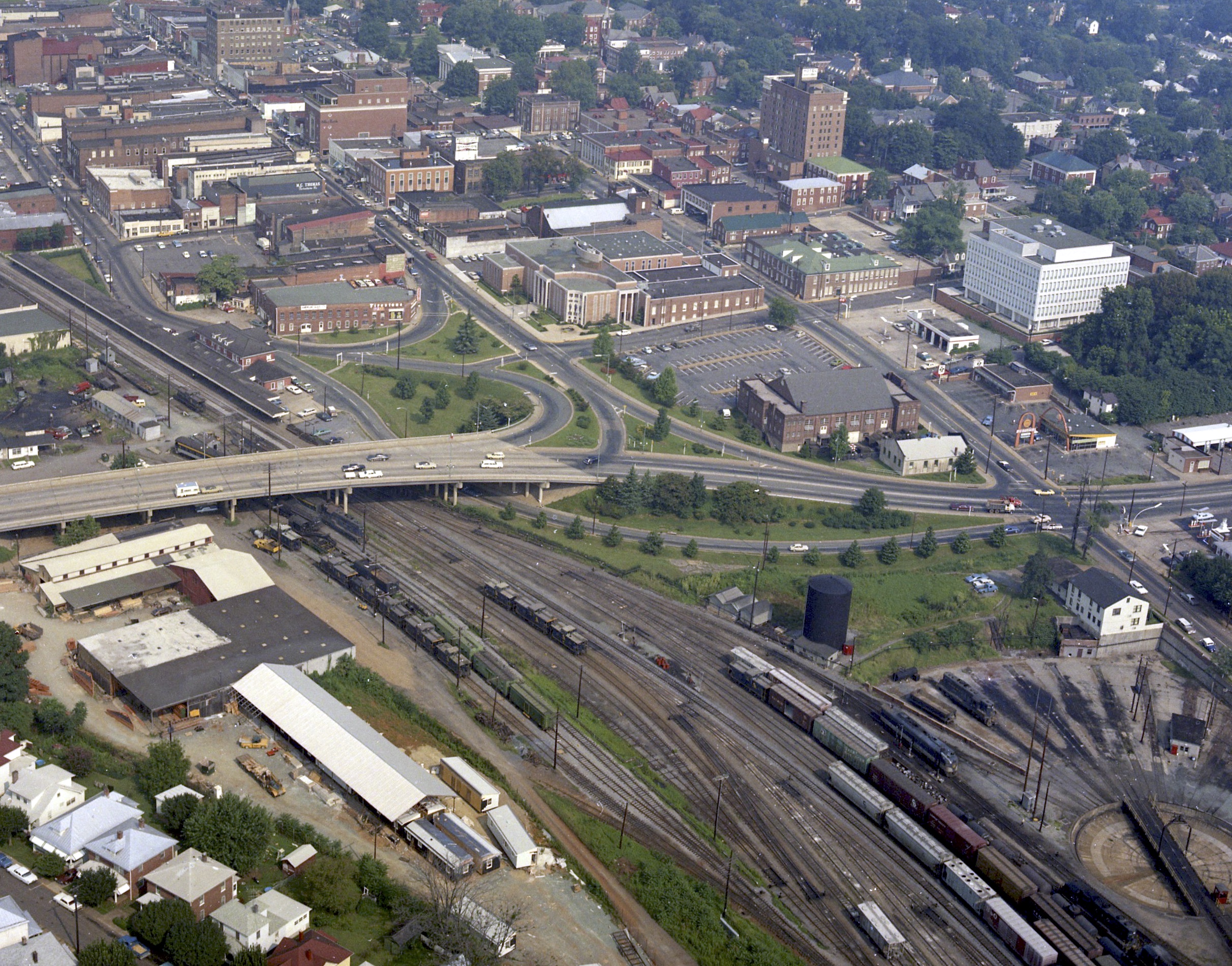
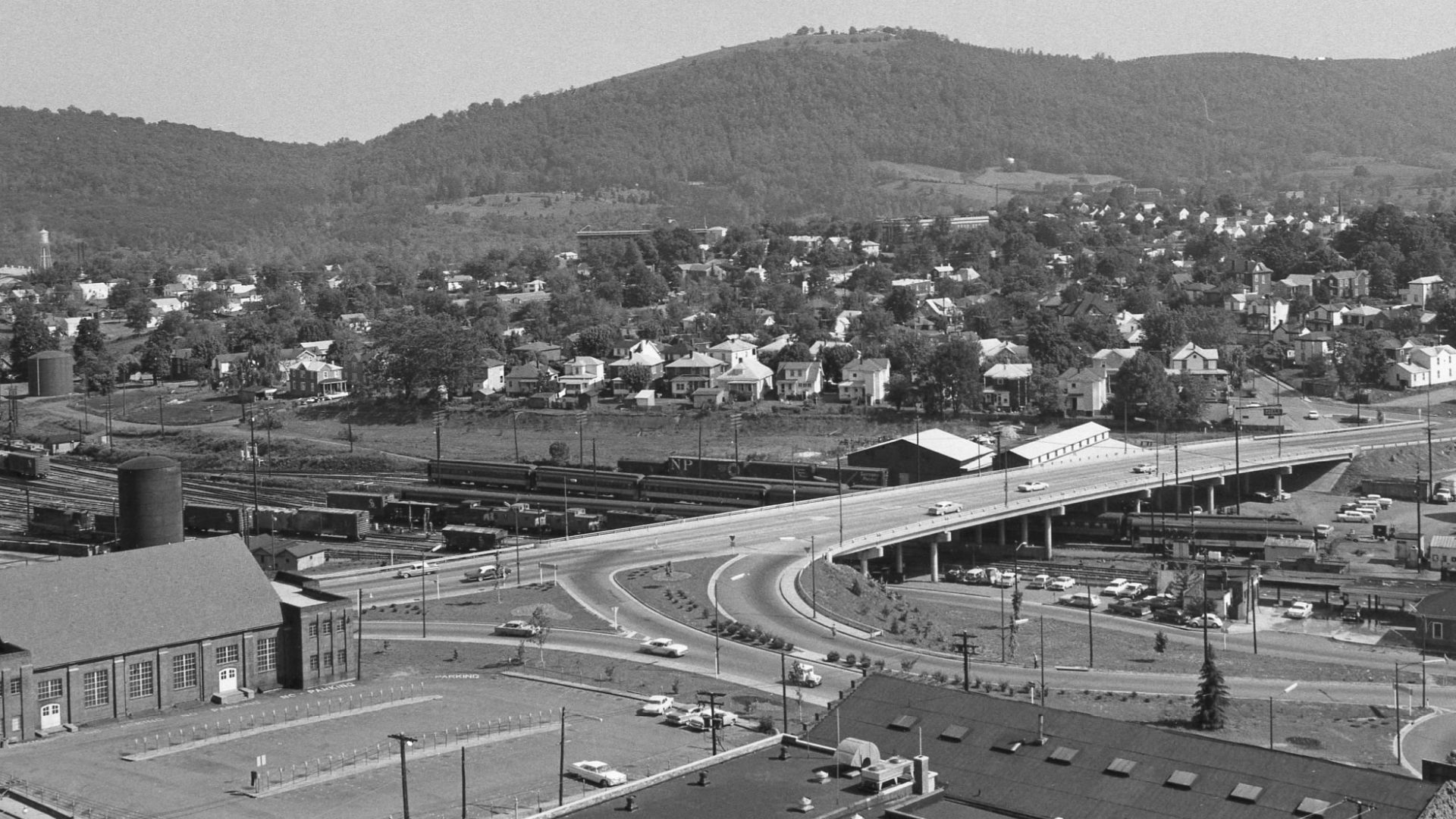
This aerial view from the 1970s shows the old C&O railroad yard including a turntable (minus the roundhouse). Also seen here is the Belmont Bridge with ramps connecting to Main Street and Water Street. The top part of the image shows a significant portion of Downtown Charlottesville including City Hall, and the Monticello Hotel.

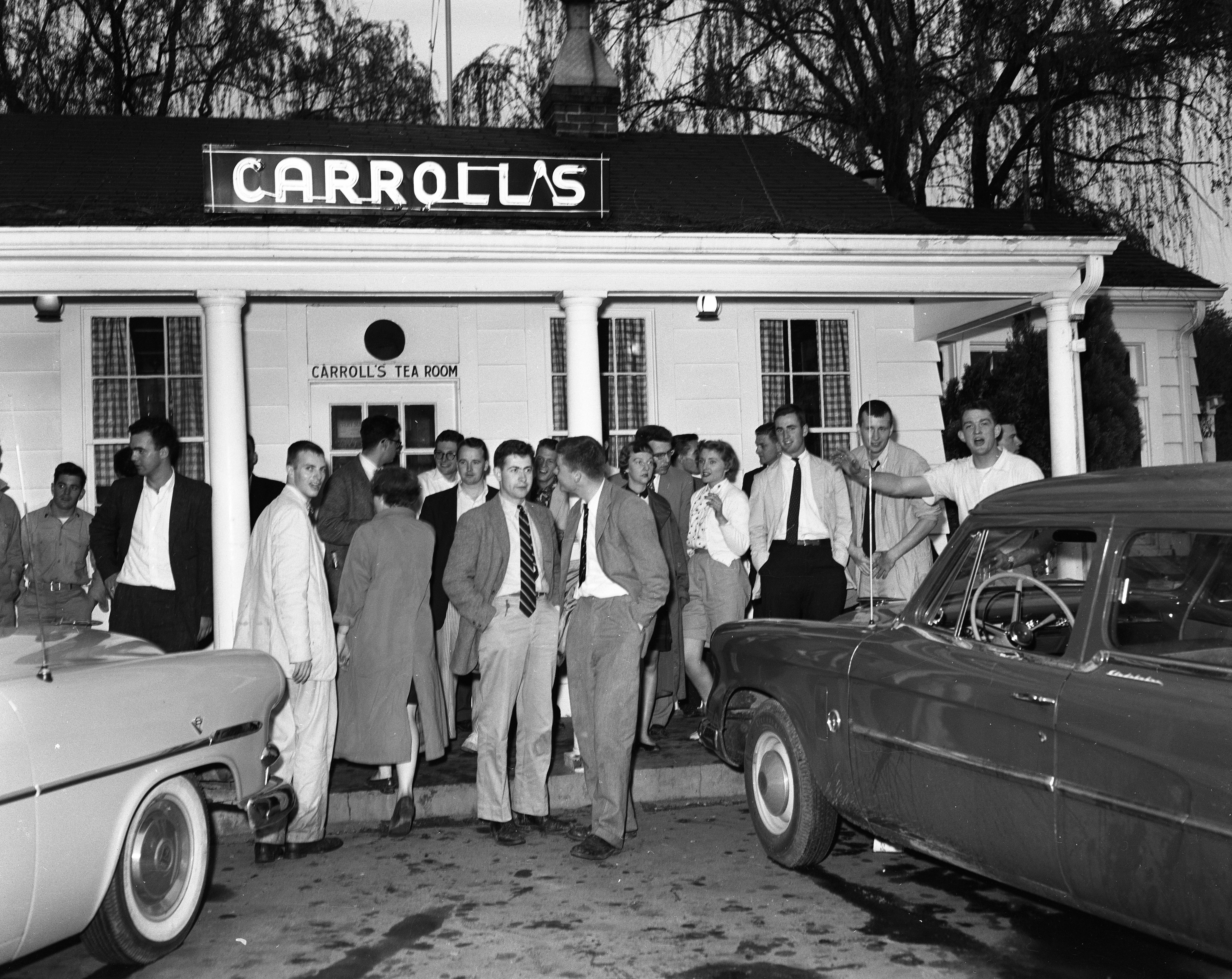
A typical weekend crowd at Carroll’s Tea Room at the intersection of Barracks Road and Emmet Street. The roadhouse was a popular watering hole for UVA students in the 1940s and 50s. It was removed to make room for Barracks Road Shopping Center which opened in 1959. The sign in the parking lot boasted “Warm beer – Lousy food” and alerted patrons that there was “No Carroll’s – No tea – No room.”

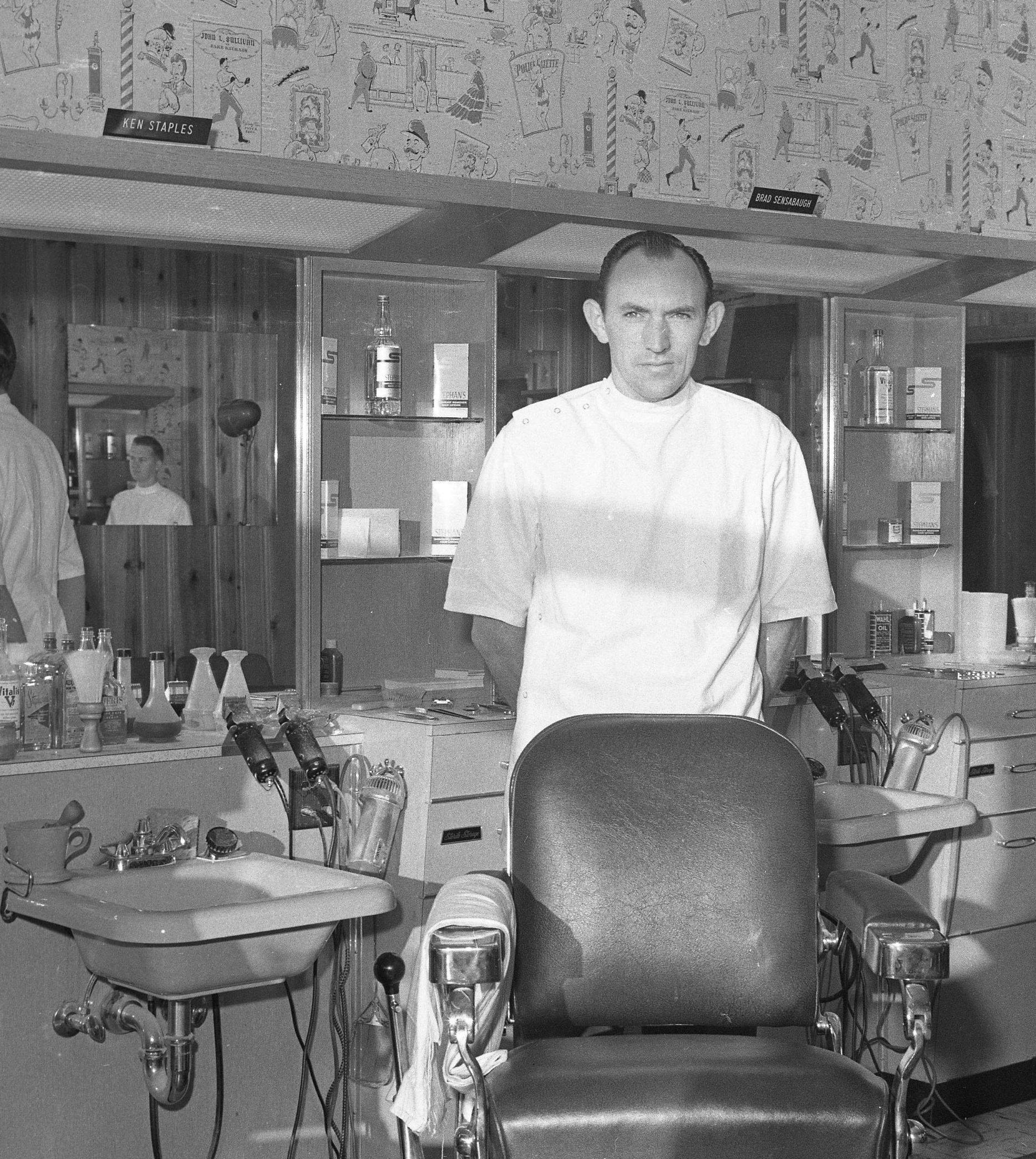
Ken Staples, a long-time barber at his shop in Barrack’s Road Shopping Center. Seen here in the 1960s, Mr. Staples led a team of barbers at his popular shop for decades. He died in November, 2017 at the age of 85.

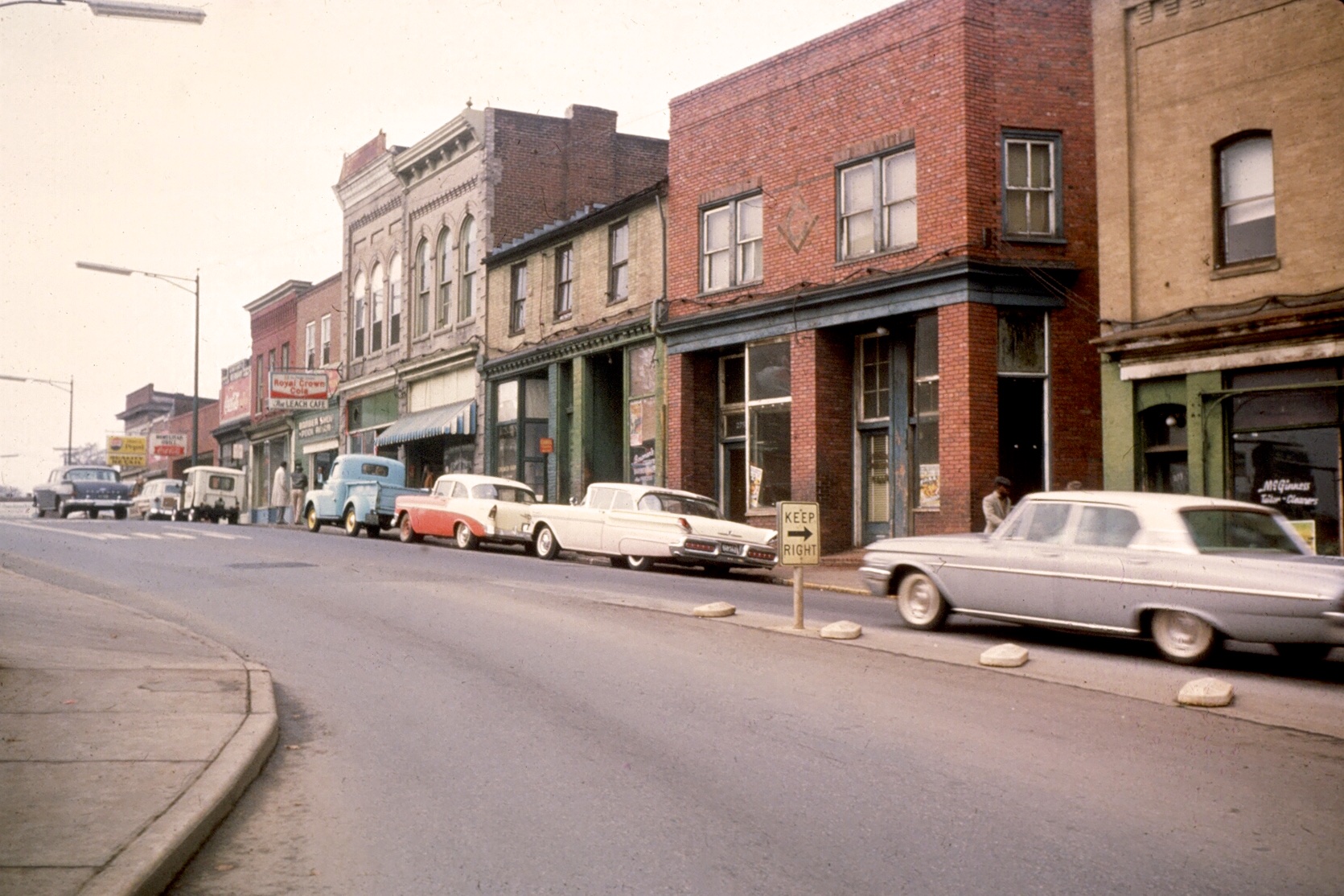
Main Street, Vinegar Hill, circa 1960.

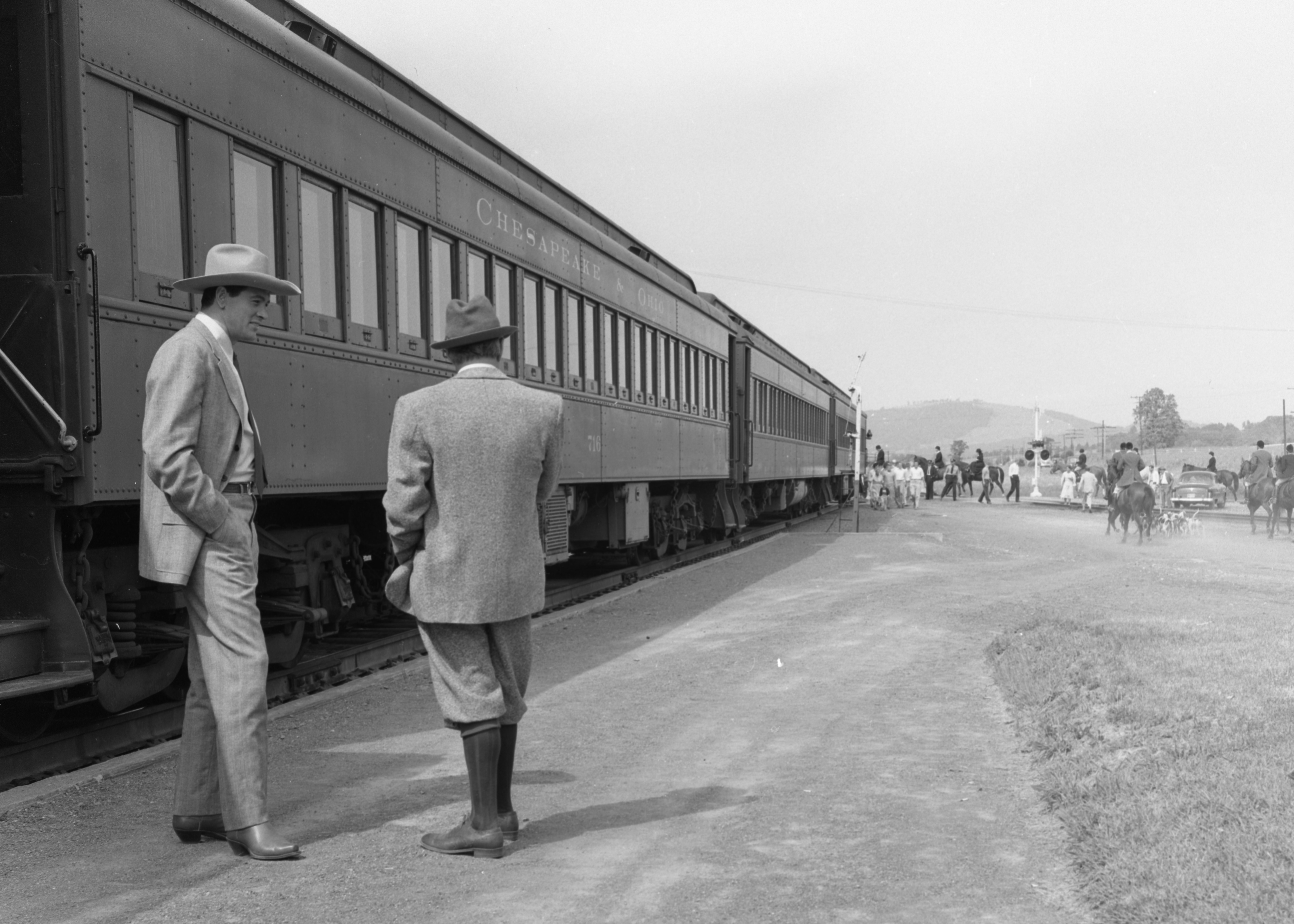
In June of 1955, the film production crew for “Giant” came to town to film the opening sequences for the epic movie that would be released the next year. In this shot, actors Rock Hudson and Paul Fix stand outside the train that brings Hudson’s character to the fictitious town of Ardmore, MD. The railroad depot at Keswick was used and local riders were recruited for the hunt scene that opens the film.

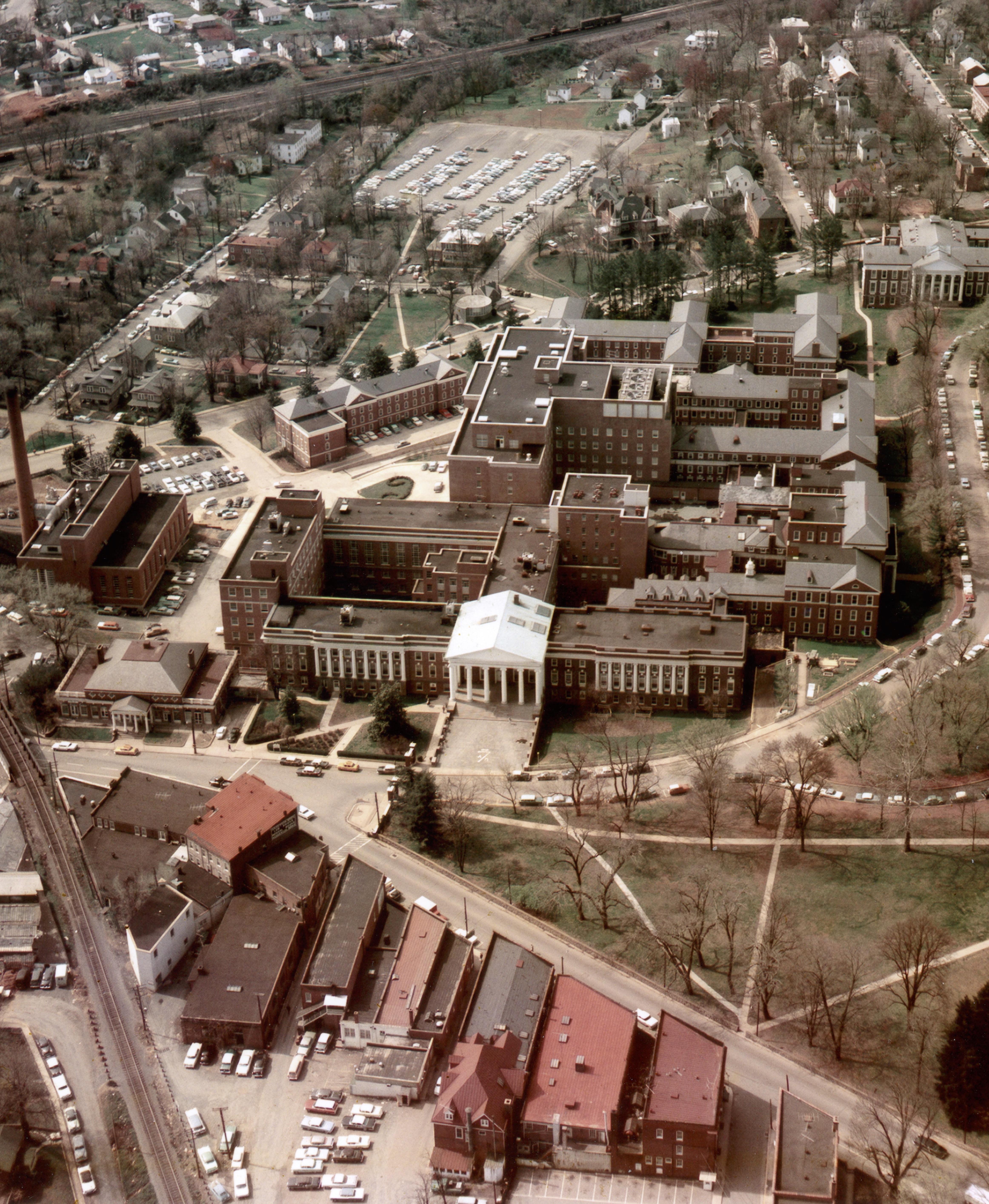
This aerial photograph from 1963 shows the Medical School and Hospital at UVA as it looked in those days. The lower part of the view shows the rooftops of several of the buildings on The Corner, the commercial area along University Avenue.

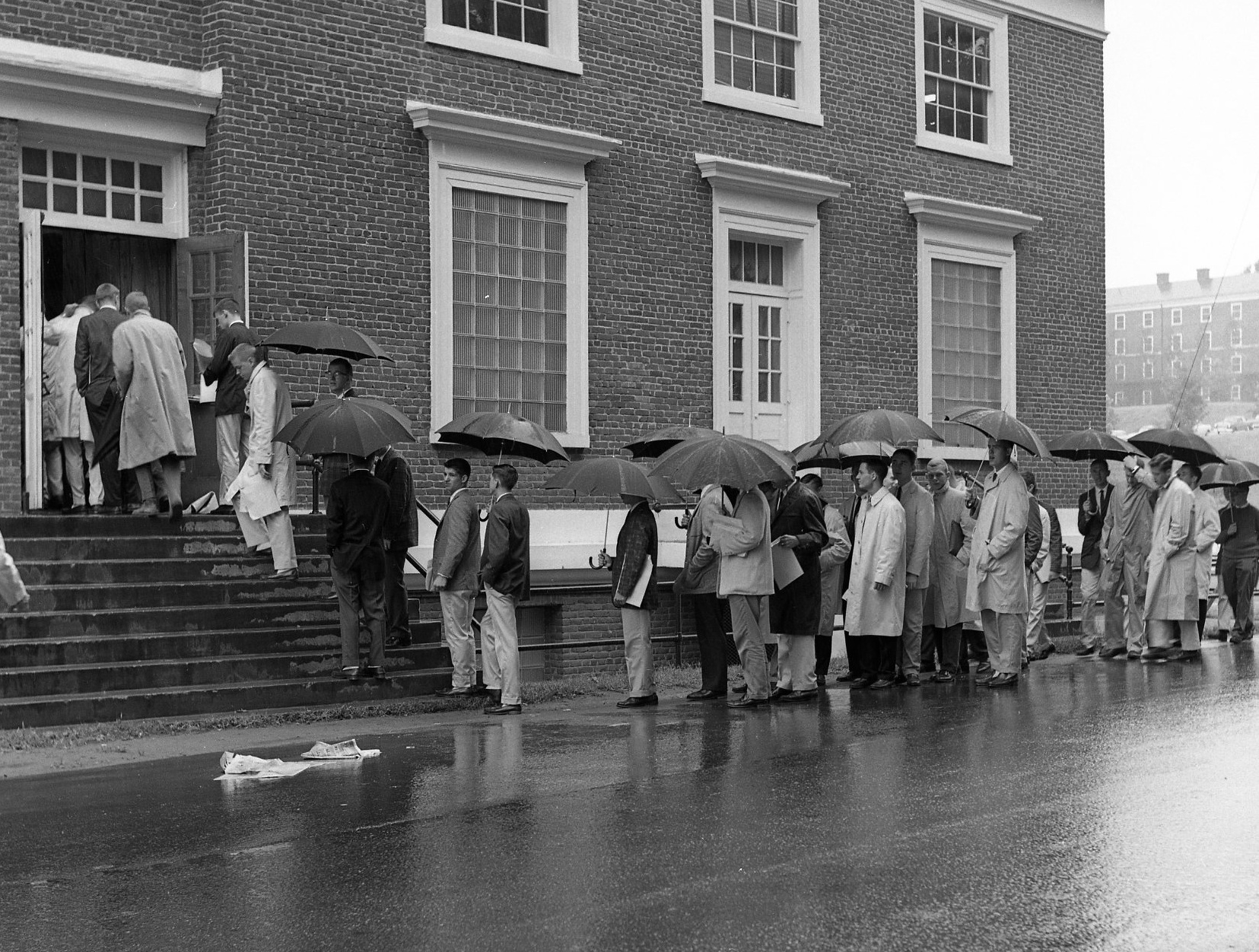
A rainy registration day for classes in the 1950s at Memorial Gymnasium, University of Virginia.

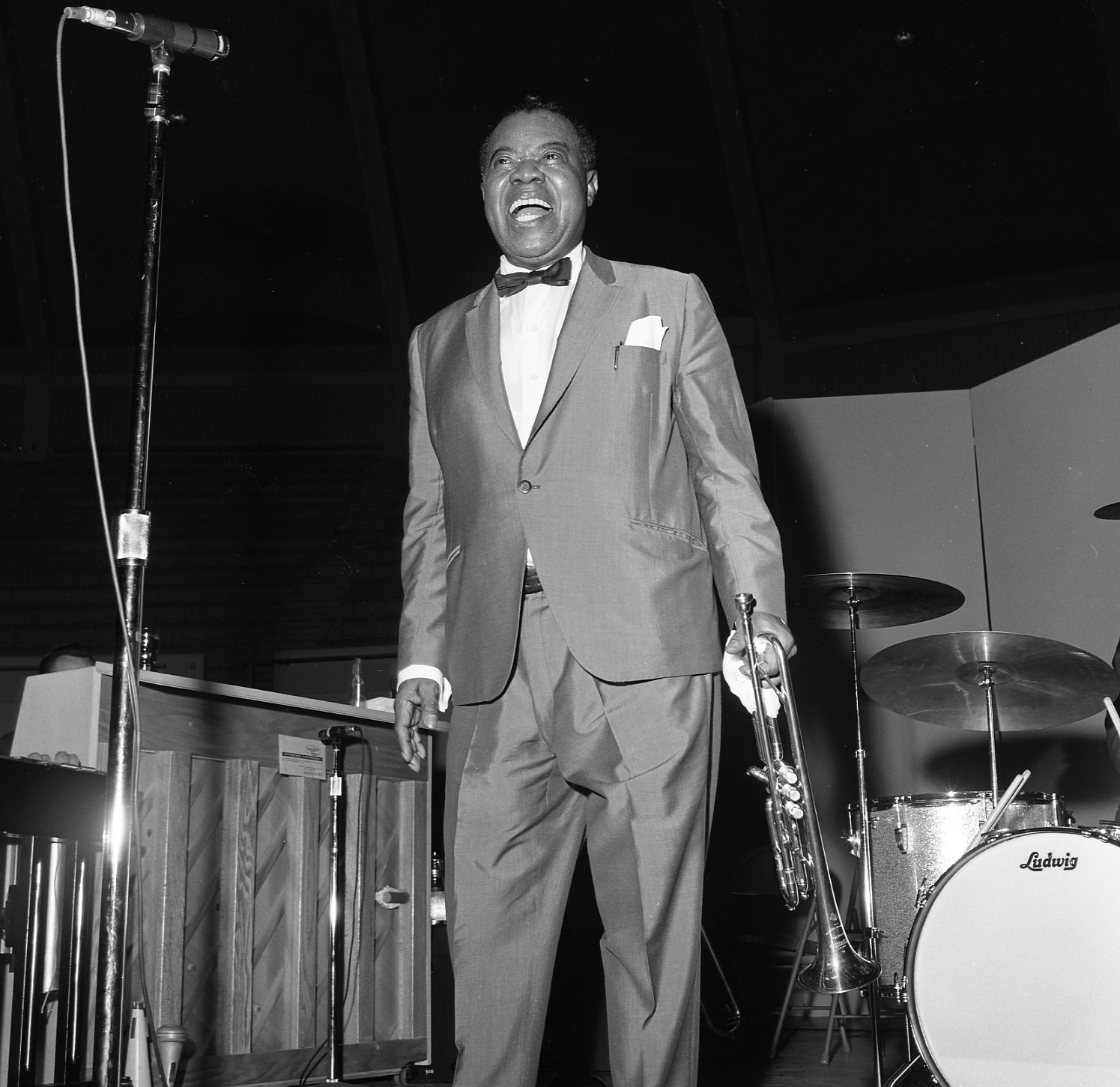
Louis “Satchmo” Armstrong preparing for a concert at University Hall at UVA in the 1960s.

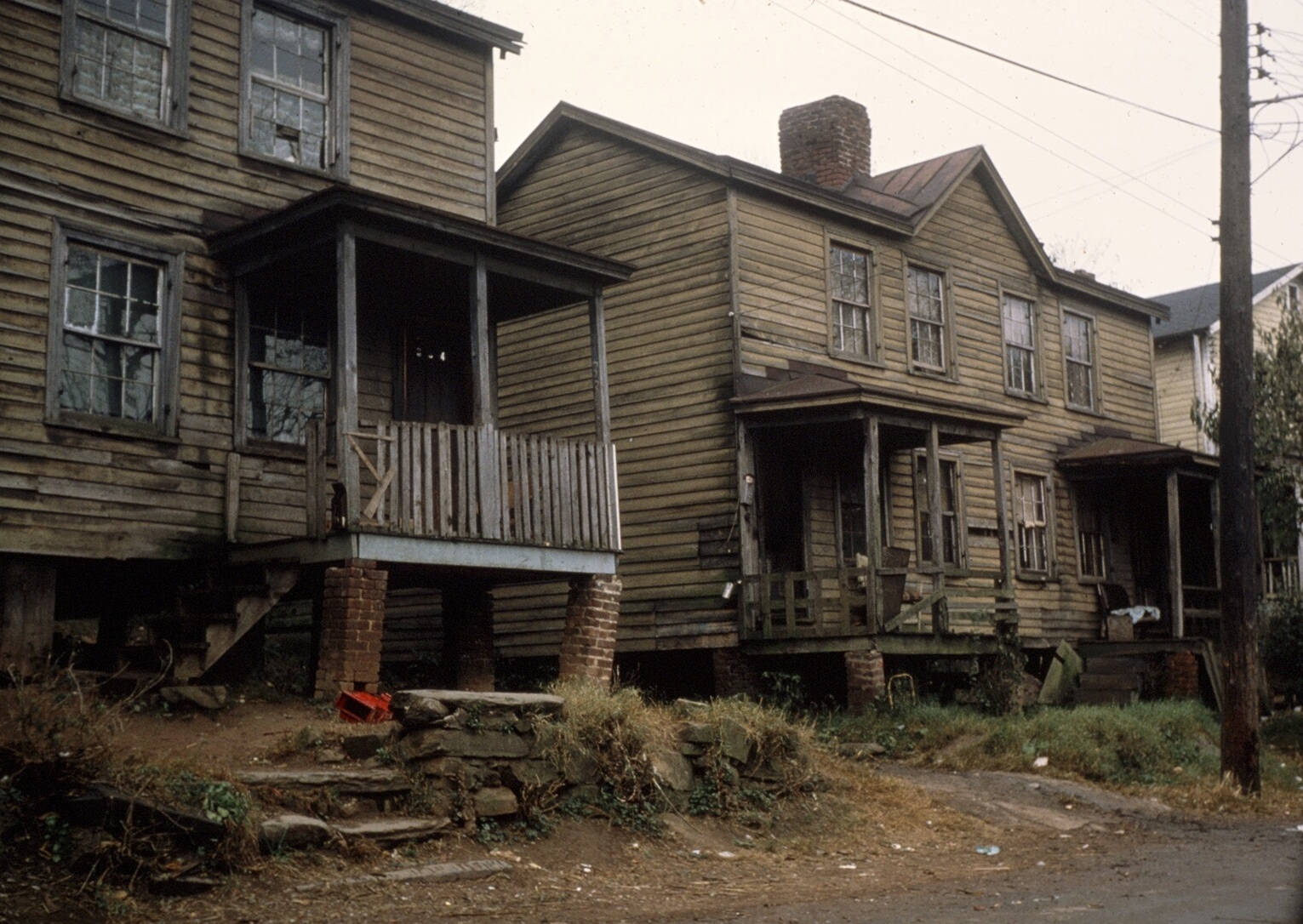
Residential properties in the neighborhood just below the commercial part of Main Street known as Vinegar Hill. Both commercial and residential properties were demolished in this part of town in the early 1960s as part of an urban renewal program.

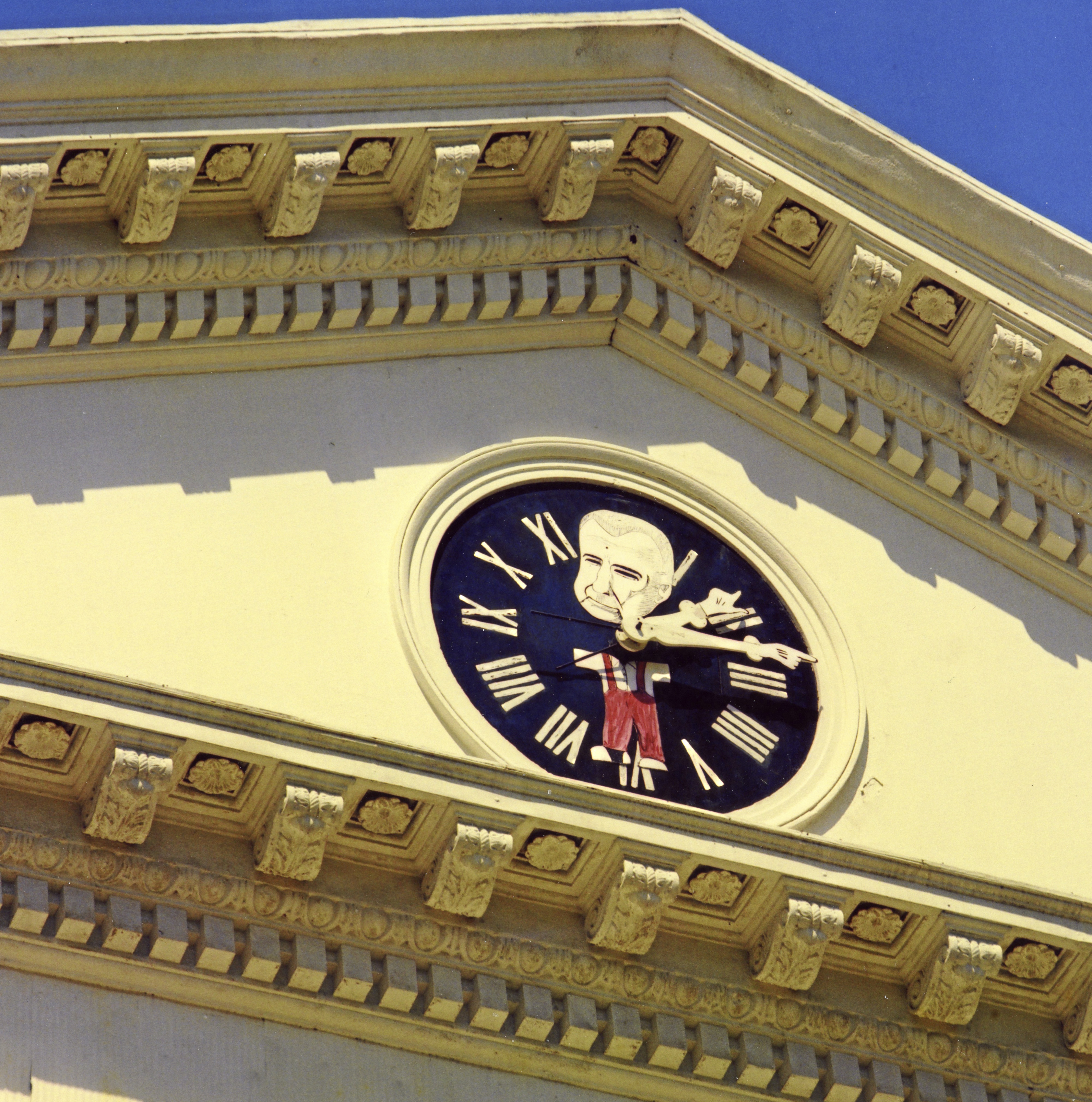
The clock on the Rotunda was occasionally the subject of pranks over the years including this one during the Nixon Administration featuring Vice President Spiro Agnew.

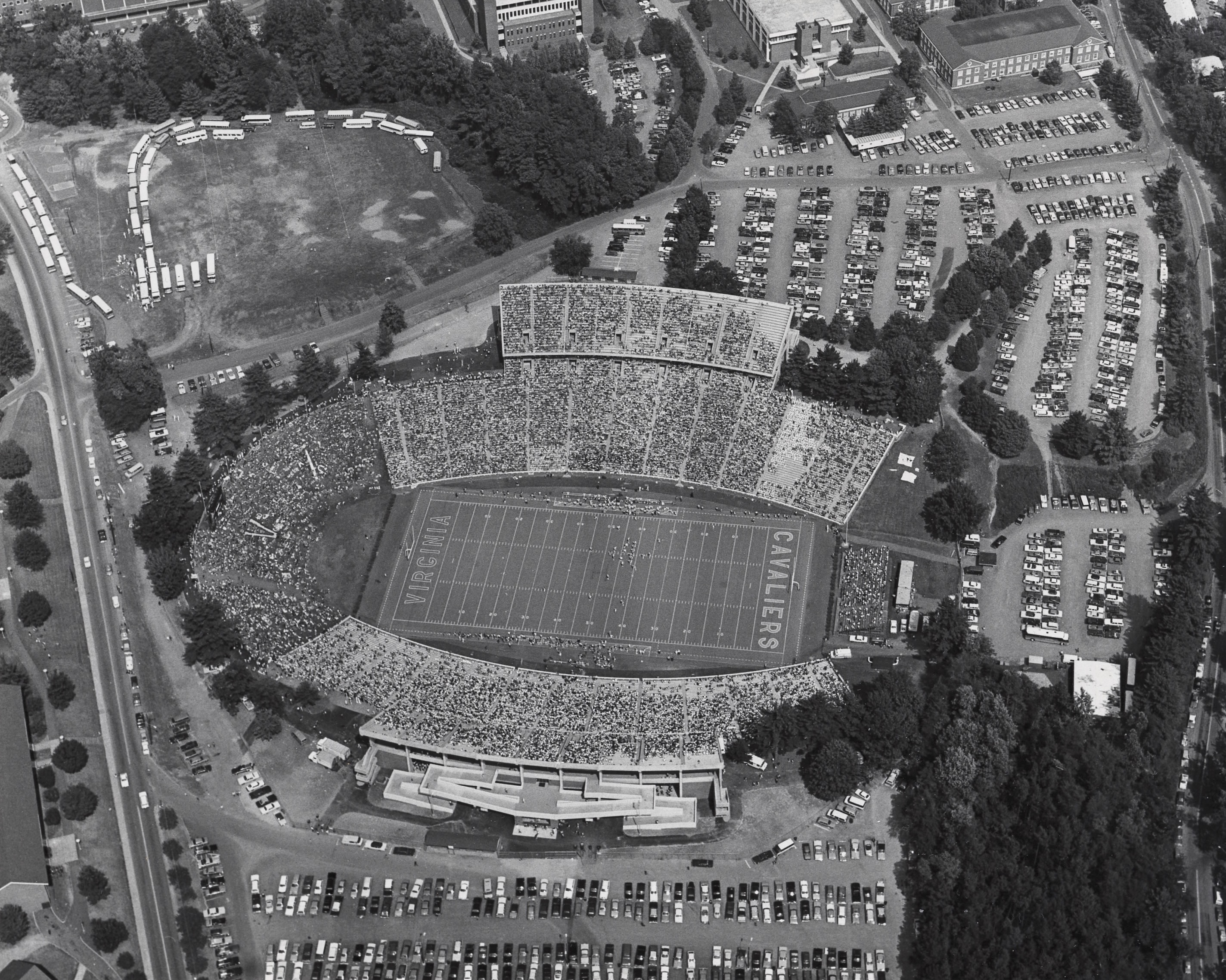
An aerial view of Scott Stadium at UVA taken during a football game in September of 1980.

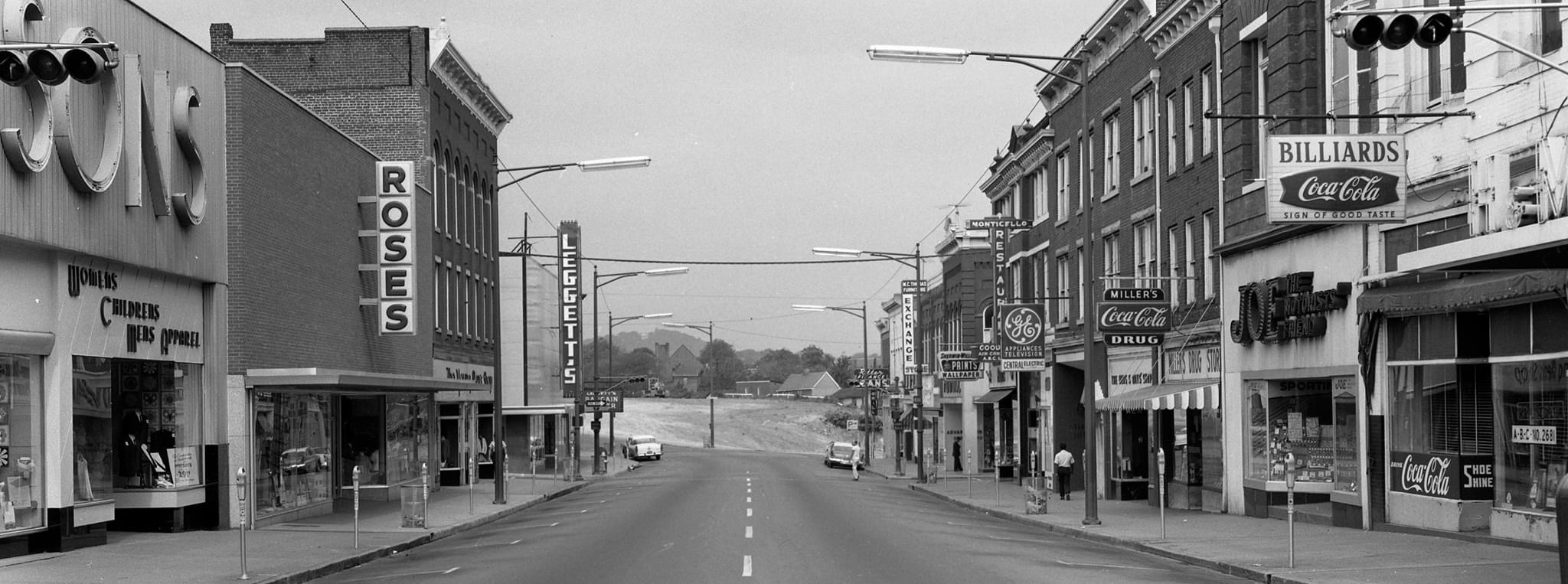
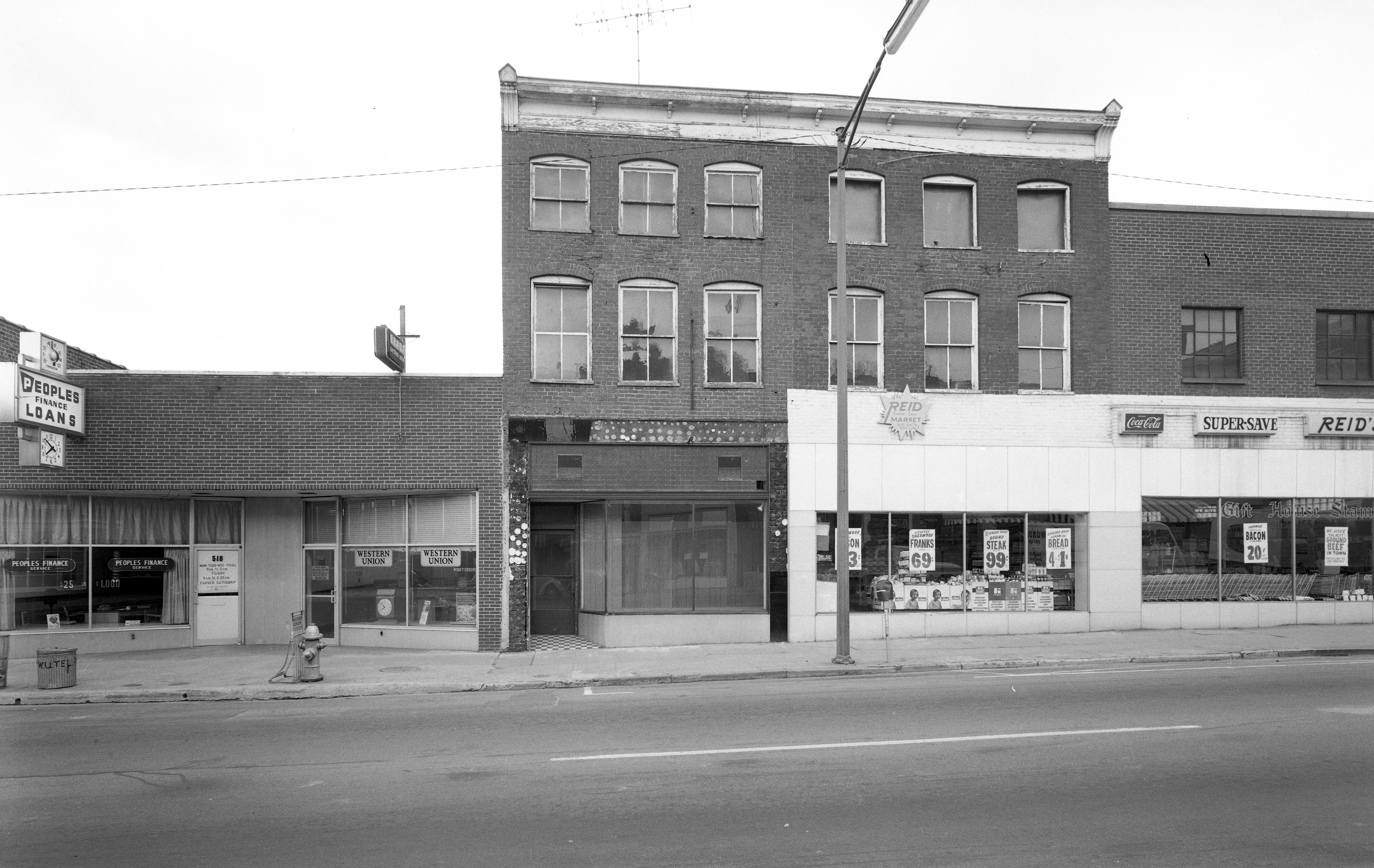
500 Block of East Main Street in Downtown Charlottesville. This view of the south side of the street gives a sense of what it looked like in the 1960s/early 70s. Reid’s Market on the right was a full-service grocery store with parking underneath the building. It would be lost to fire around 1980. Main Street was drivable at the time but by the mid-1970s this part of Main Street would be bricked and several blocks of Main would become the Downtown Pedestrian Mall.

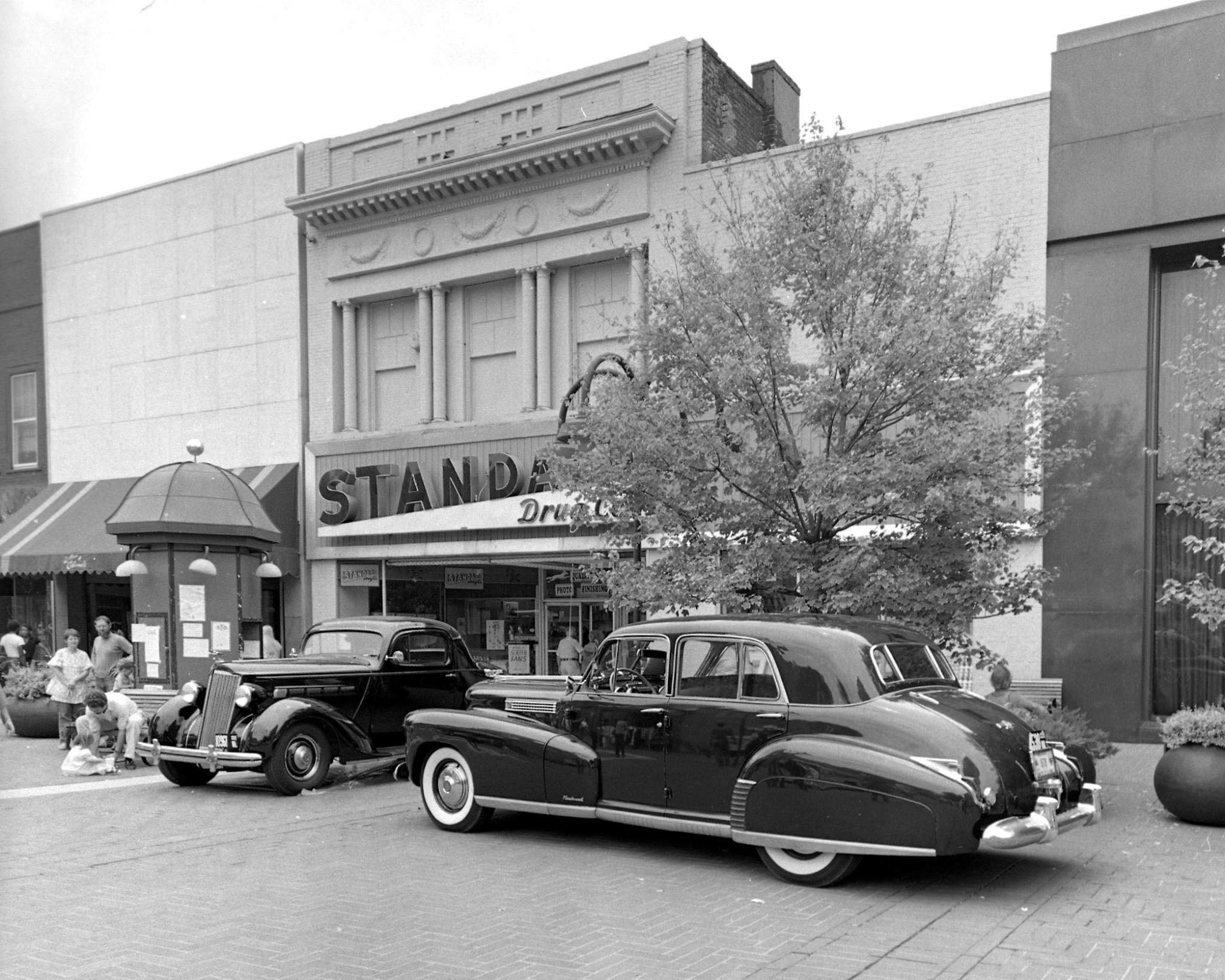
Ed Roseberry’s 1941 Cadillac Fleetwood at a car show in the Downtown Mall, 1980. The location is the 200 block of East Main Street, across from The Paramount Theater. Standard Drug, seen here, is now the location of CVS (note the second story of the building looks pretty much the same today). The Cadillac is still humming along, as is Mr. Roseberry now well into his 90s.

Main Street in Charlottesville (now the Downtown Pedestrian Mall). This late 1950s photo shows the holiday decorations along the street. Roseberry took the photograph from a roof top of a building at the east end of Main Street which stood approximately where City Hall is today. Many of the building seen in this view still stand today.

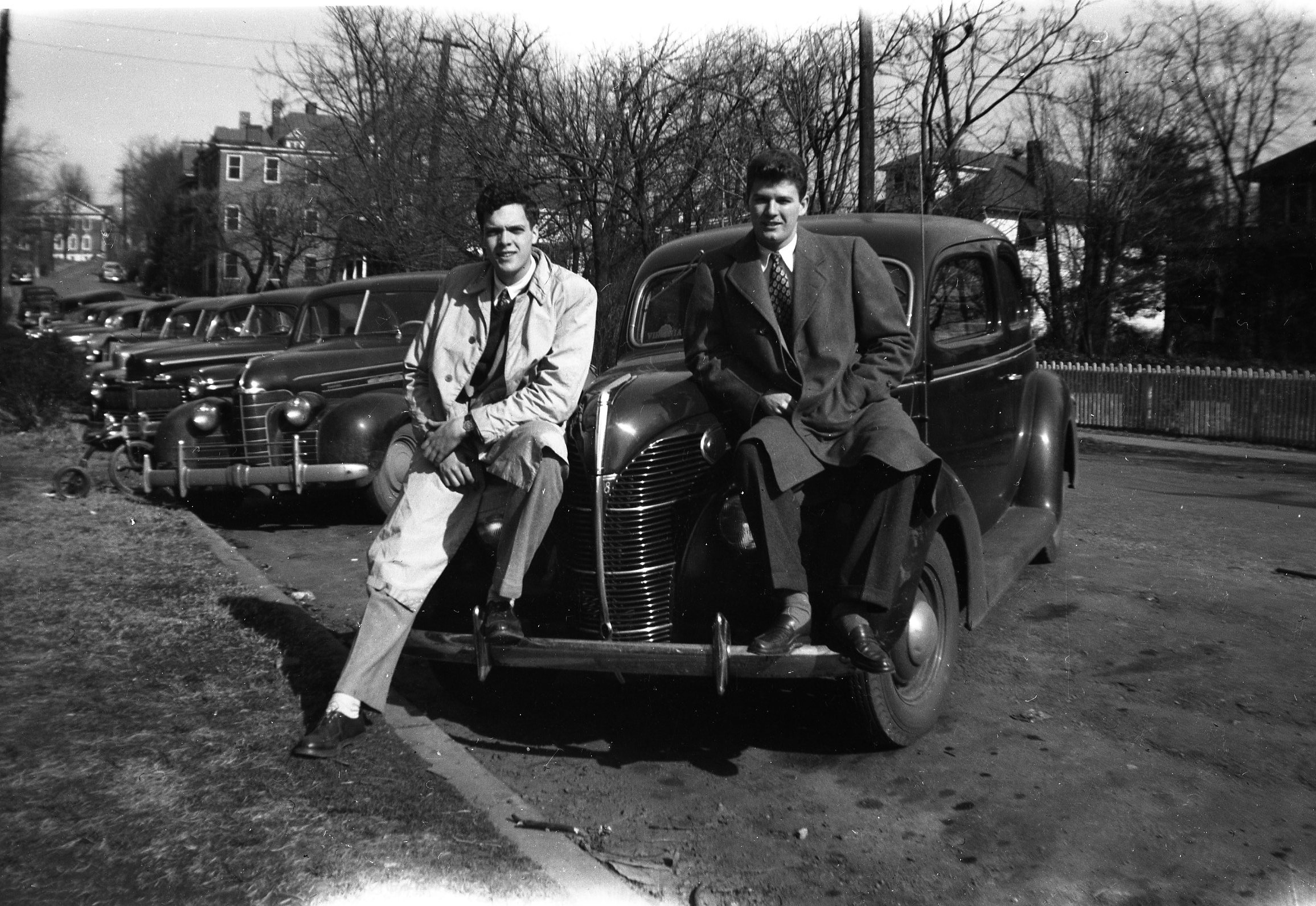
A very early photograph from Ed Roseberry taken near UVA on Brandon Avenue. Ed’s brother, Bob Roseberry, is on the right. Their friend David Walker is on the left. The view is looking north from the Brandon Avenue Apartments toward The Lawn. The building in the far left distance is Randall Hall (College of Arts & Sciences) which was dormitories at the time. That building is still there but no longer visible from this spot. The photograph was probably taken in the late 40s. Ed graduated from UVA in 1949 at age 23 after serving in WWII in the Pacific.

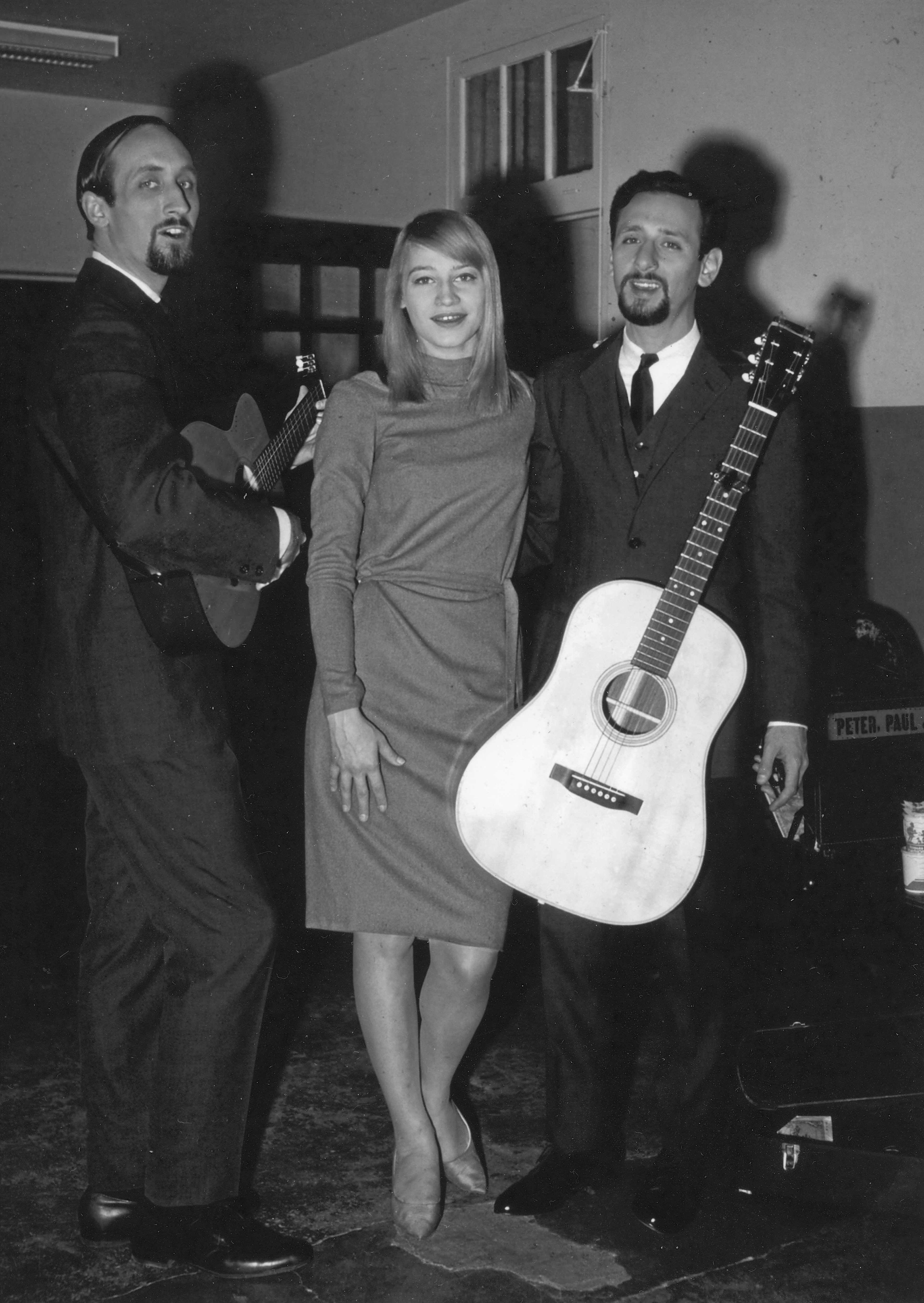
Noel Paul Stookey, Mary Travers, and Peter Yarrow, better known as the folk music trio, Peter, Paul and Mary. Seen here backstage at a performance at the University of Virginia in 1962. They were a very new musical act at the time, having just been formed the previous year from the NYC folk scene by Albert Grossman who also managed Bob Dylan, among others.

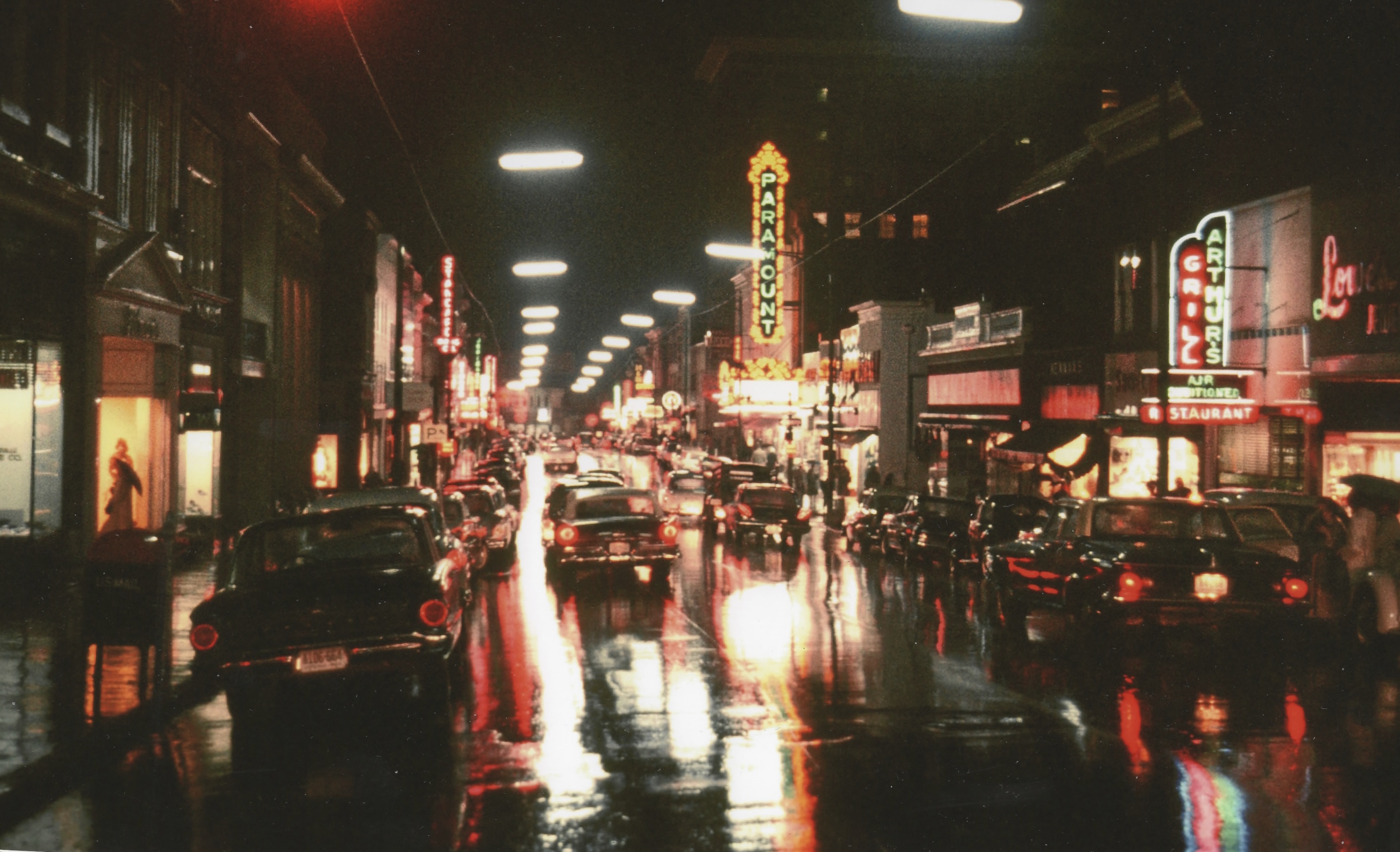
This is a rare image from Ed Roseberry in that it is both a night time shot and in color during a time he was shooting mostly in B&W. This photograph was taken in October 1963 on a rainy night downtown. The view is from the 300 block of East Main Street, looking west and shows the Paramount Theater in the distance with its original lighted blade sign above the marquee. That sign was removed sometime during the 1960s and the theater would close in 1974. The theater would be reopened in December 2004 but it would be another 11 years before the restoration of the historic theater was completed with the installation of its iconic blade sign, a replica of the original from 1931.

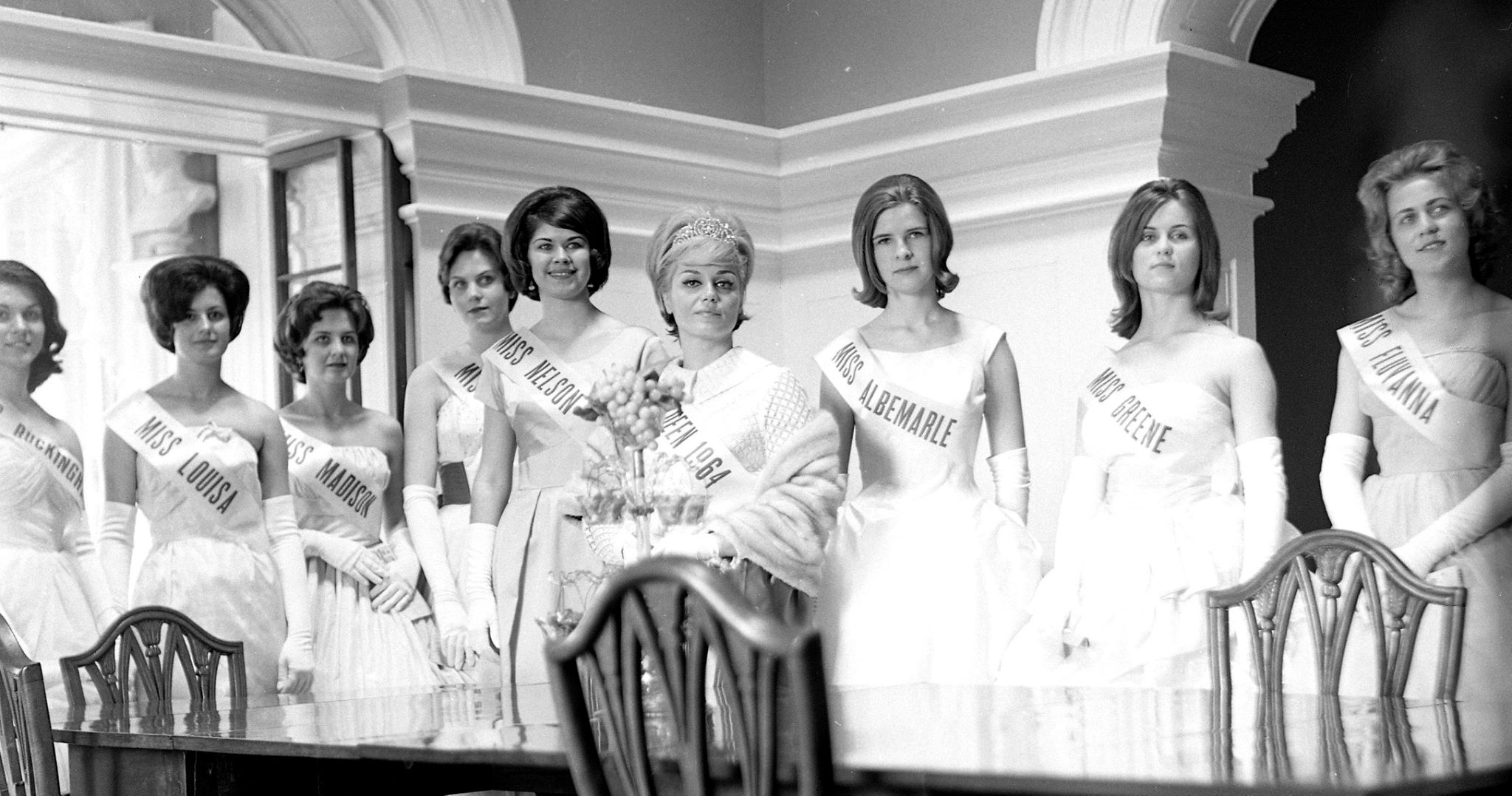
Dogwood Court, Dogwood Festival, Spring 1964. The Court is made up of young ladies from Charlottesville and surrounding counties with the 1964 Dogwood Queen, Janice Harper, standing in the center. Roseberry took this shot while the group was touring Monticello during the festivities.

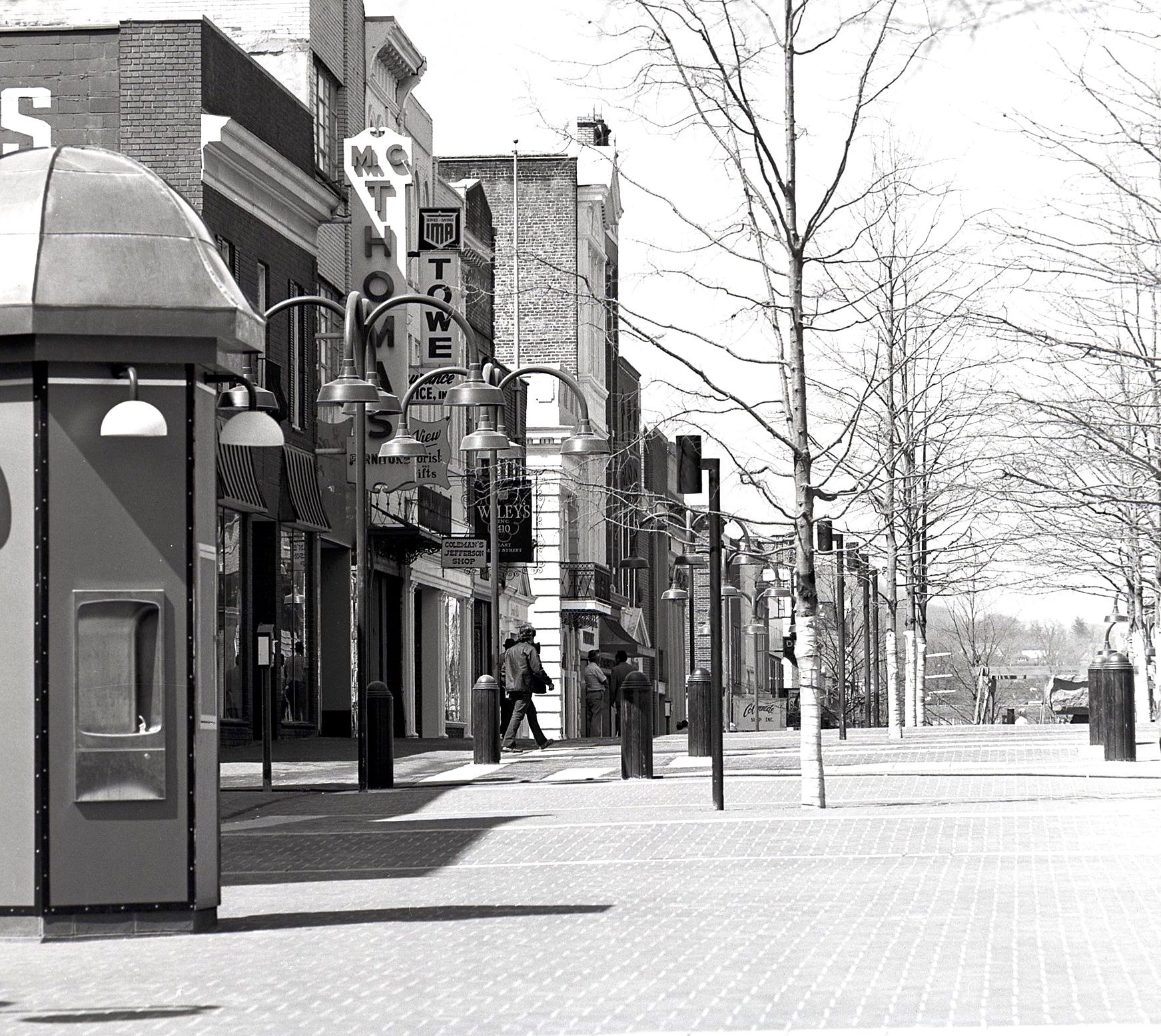
The 400 block of East Main Street circa 1980, showing what the Downtown Pedestrian Mall looked like in the early years. The willow oaks seen here have grown rapidly in the 4 decades since this this photo was taken and now tower above the rooflines and shade the brick pavement below. Note the water fountain kiosk at the left.

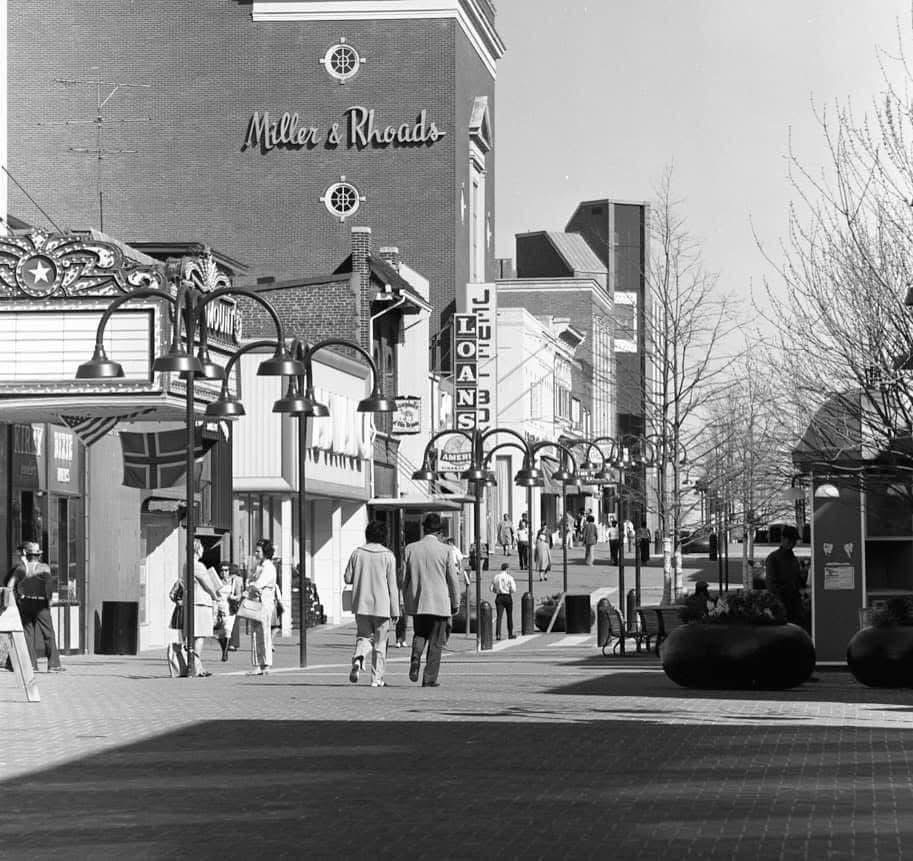
Another view (circa 1980) of the early days of the Downtown Pedestrian Mall showing the still familiar landmarks, The Paramount Theater (marquee in the foreground at left), The Miller & Rhoads building, and (in the distance) the newly built parking garage.

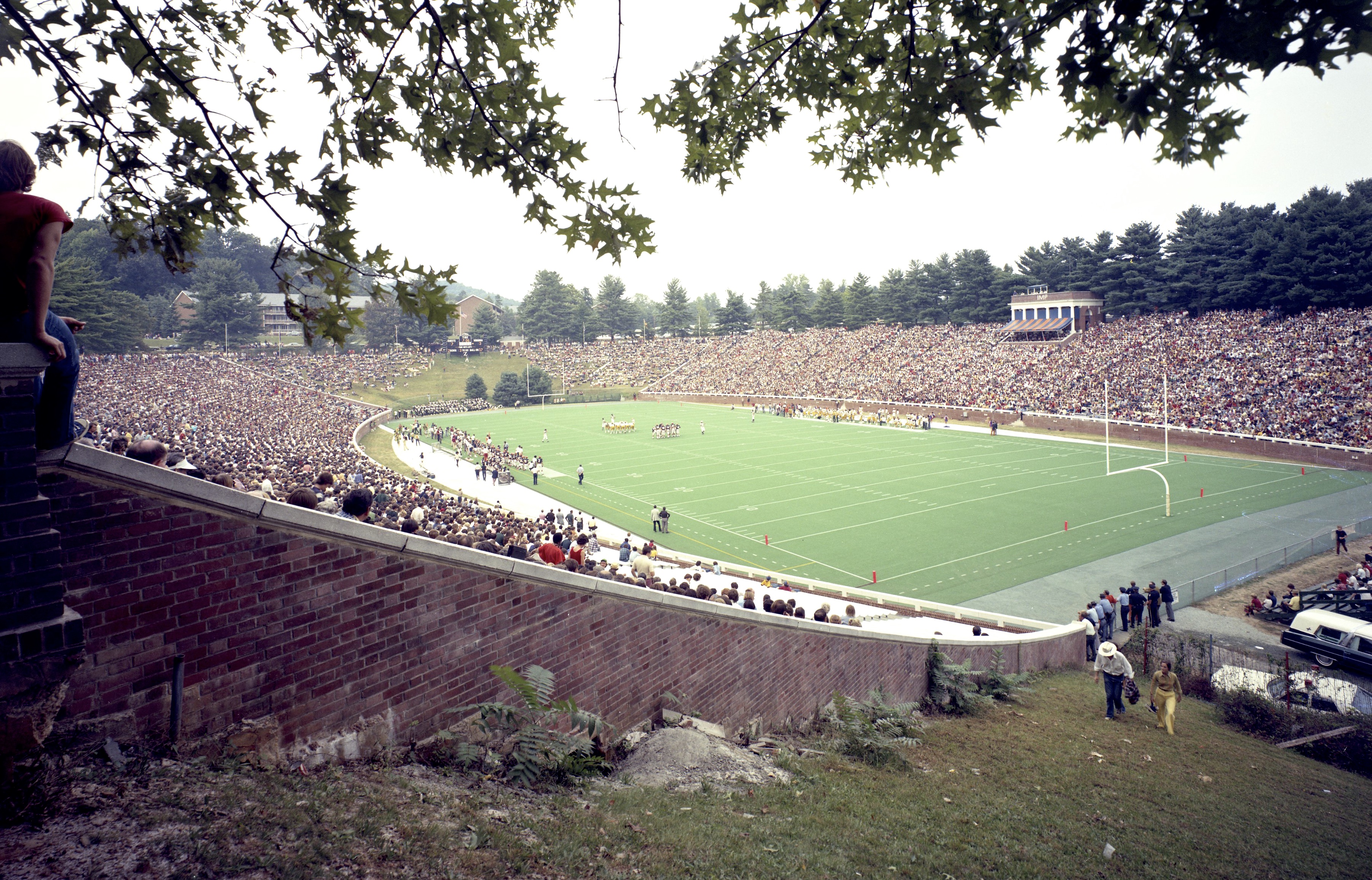
Scott Stadium, home of the Virginia Cavaliers. Originally built in 1931, the stadium is seen in this photograph taken in September, 1974 a few years before the upper decks were added. Note the hearse parked in the lower righthand corner; hearses were once commonly used as ambulances.

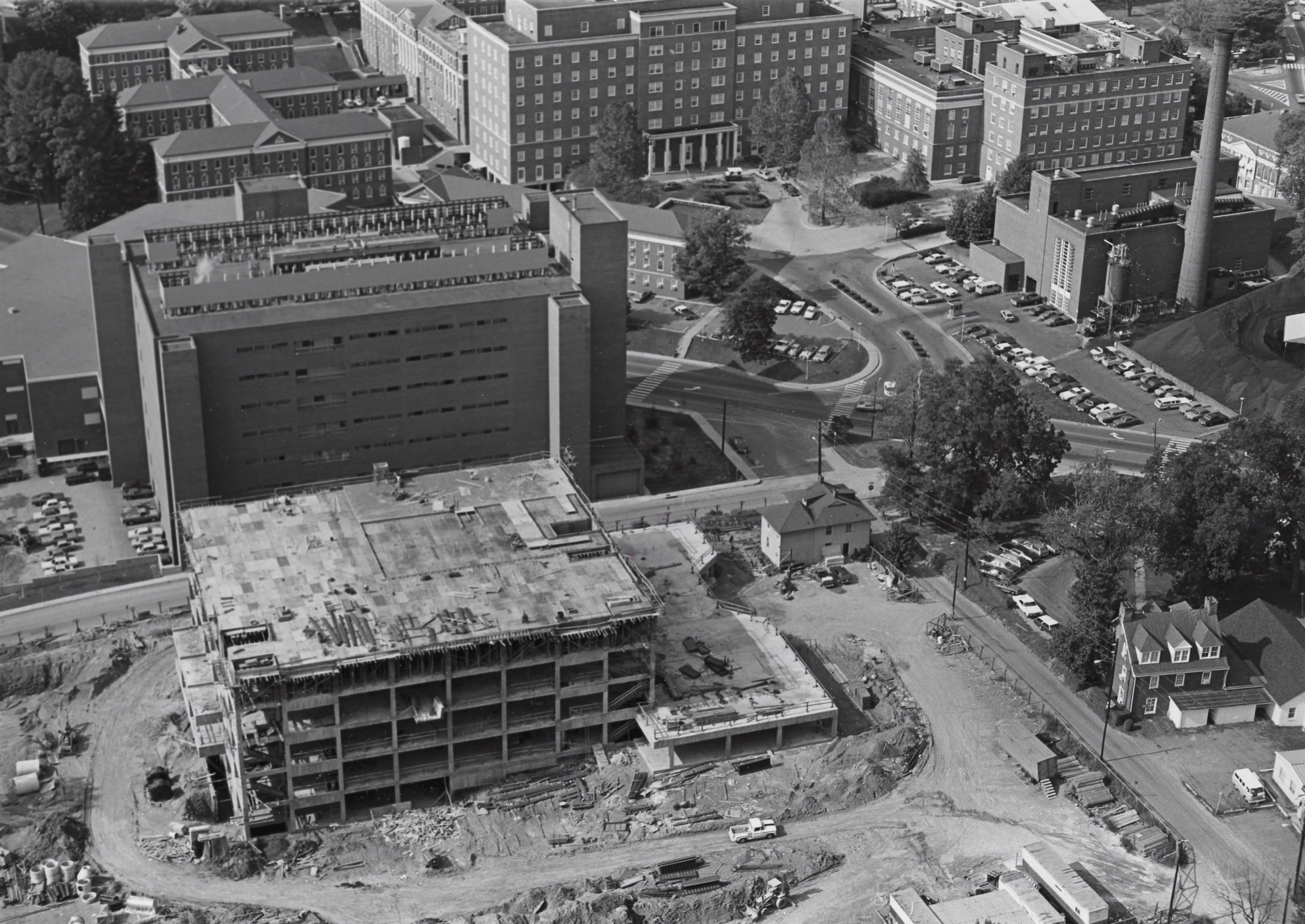
UVA Medical Center, circa 1977. The building under construction in the foreground is the Primary Care Center. Old Pinn Hall (Jordan Hall) is just behind it. There was actually a street (Park Place) between the two buildings at the time. Lee Street, seen in the lower right hand corner, looks very different today. Note the large pile of coal near the heating plant at the right of this view. The older portion of the hospital (1950s and earlier) is partially visible at the top of the image.

All photographs by Edwin S. Roseberry. Images not to be used without permission.
© C’ville Images, 2018-2025